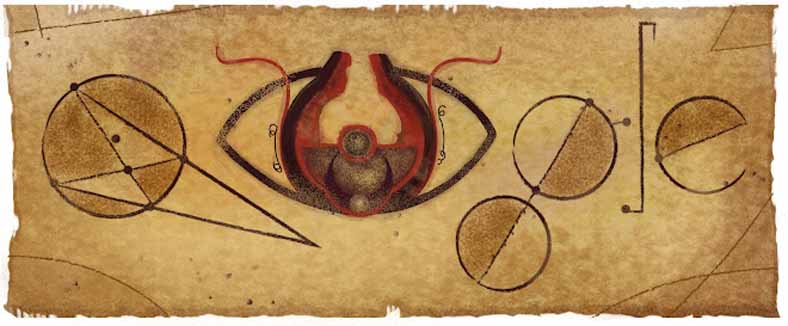
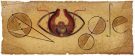
Google Doodle, from time to time, honours prominent figures from the history of Muslim civilisation - not only political or religious leaders, but also a wide spectrum of intellectuals: scholars, poets, scientists, astronomers, travellers, and physicians -individuals whose contributions have left a lasting legacy on human civilisation. These figures advanced knowledge and innovation in fields ranging from mathematics and medicine to engineering, optics, and philosophy, shaping the foundations of our modern world. On July 1st, 2013, Google commemorated the 1048th birthday of Ibn al-Haytham with a dedicated Google Doodle as "Alhazen's 1048th Birthday", acknowledging the profound influence of this pioneering thinker.
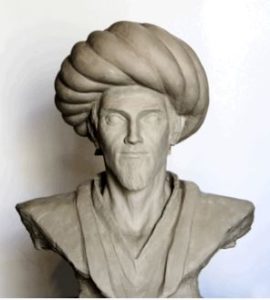
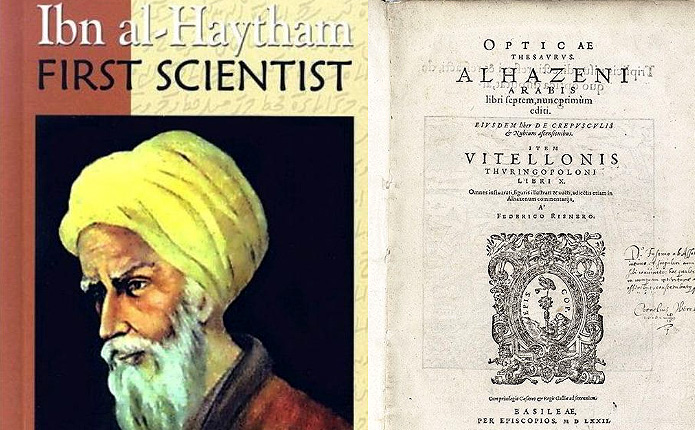
Ibn al-Haytham (Latinized as Alhazen; full name Abū ʿAlī al-Ḥasan ibn al-Ḥasan ibn al-Haytham, c. 965 – c. 1040), also known in Western texts as Alhacen or Alhasen, was a pioneering mathematician, physicist, and astronomer of the Islamic Golden Age. He is widely regarded as the “father of optics” for his groundbreaking work on light, vision, and visual perception. Through rigorous experimentation, he was the first to explain that “vision occurs when light reflects off an object and enters the eyes”, a revolutionary departure from the Greek theories of visual rays emitted by the eye.
More importantly, “Ibn al-Haytham championed an early form of the scientific method”, emphasising observation, experimentation, and verification. He believed that scientific claims must be supported by reproducible experiments and mathematical reasoning. This method, articulated centuries before the European Renaissance, laid the groundwork for empirical science.
His magnum opus, the Kitāb al-Manāẓir (Book of Optics), written between 1011 and 1021 while living in Cairo, became one of the most influential scientific texts of the Middle Ages. When it was later translated into Latin, it profoundly influenced European scholars such as Roger Bacon, Johannes Kepler, and even Leonardo da Vinci.
A true polymath, Ibn al-Haytham also wrote on philosophy, medicine, engineering, theology, and astronomy, producing over 200 works, many of which were later studied across both the Islamic and European civilisations.
One of his famous quotes reveals his intellectual integrity and scientific rigour:
“If learning the truth is the scientist’s goal…
then he must make himself the enemy of all that he reads.” Ibn al-Haytham
Born in Basra, in present-day Iraq, to an Arab or Persian family, Ibn al-Haytham lived during a time when the region was part of the Buyid Emirate. Ibn al-Haytham spent most of his productive years in Cairo, where he authored treatises and taught members of the nobility. His influence extended beyond the Islamic world; in medieval Europe, he was revered as Ptolemaeus Secundus (“The Second Ptolemy”) or simply referred to as “The Physicist.”
His legacy is a powerful reminder that scientific inquiry transcends cultural and geographical boundaries and that the advancement of human knowledge has always been a shared global endeavour. Ibn al-Haytham’s insights into optics and scientific methodology continue to shape our understanding of the natural world to this day.
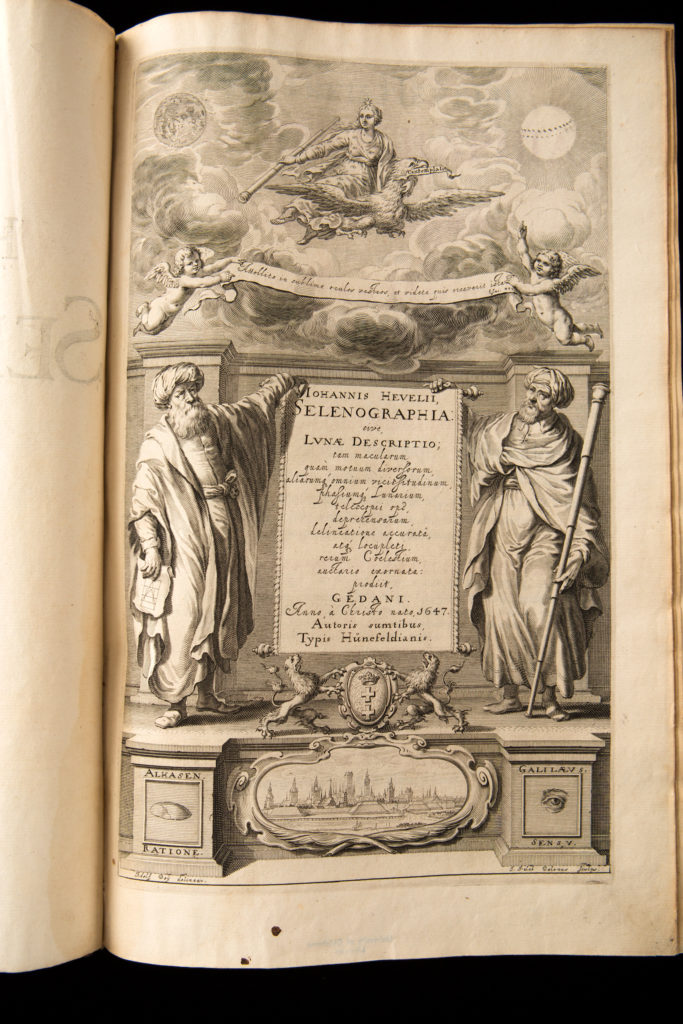
Johann Hevelius, Selenographia (Gdansk, 1647)
Honouring prominent figures as a sign of respect and appreciation is a century-old habit. 17th-century Polish astronomer Johannes Hevelius, for example, created what could act as a Google Doodle of the past on the front piece of his famous Selenographia. The image shows two prominent scientists as a sign of respect and appreciation from Hevelius for the work they did, and the world benefited from it. The image depicts Galileo Galilei, who is set across the page from Ibn al-Haytham, who is considered by some as the ‘first scientist’. With an image of a brain and an engraving of ‘Ratione‘ (Reason in Latin) on the plinth holding Ibn al-Haytham, Hevelius credits him as a pioneer of the rational scientific method.
“If I have seen further… it is by standing on the shoulders of Giants.” Isaac Newton
Google Doodle, from time to time, honours prominent figures from the history of Muslim civilisation - not only political or religious leaders, but also a wide spectrum of intellectuals: scholars, poets, scientists, astronomers, travellers, and…
by Craig Aaen-Stockdale Published on: 4th July 2020
The famous scientist Ibn al-Haytham (‘Alhazen') has rightly been credited with many advances in optics and vision science, but recent spurious claims that he is the ‘founder of psychophysics' rest upon unsupported assertions, a conflation…
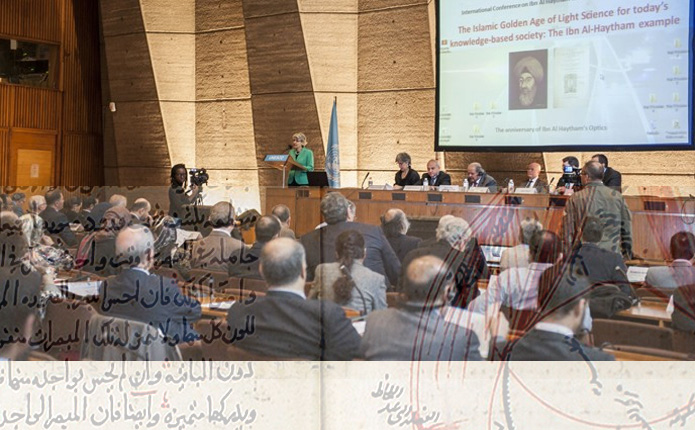
From The Opening Ceremony Of The International Year Of Light At The Unesco Building In Paris France. Ibn Al-Haytham’s Contributions To Optics And Renaissance Art Charles Falco
by Charles G. Gross Published on: 28th September 2012
Ibn al-Haytham was the major figure in the study of optics and vision in the Middle Ages and his influence was pervasive for over 500 years. In this article, Professor Charles G. Gross, a renowned…
This is a book review of Ibn El-Heysem ve Yeni Optik (Ibn al-Haytham and the New Optics) by Huseyin Gazi Topdemir published in 2008 in Turkish as the first book of a series on scientific…
This presentation focused on the historical and epistemic bearings of the scientific legacy of the celebrated polymath al-Hasan ibn al-Haytham (known in Latin as Alhazen)
This is a very short note summarizing the lecture presented by Dr Saira Malik in the Muslim Heritage Awareness Group (MHAG) meeting organized by FSTC at the Royal Society in London on March 30, 2011.…
by Charles Burnett Published on: 4th September 2023
The Optics (kitāb al-Manāzir or Perspectiva/De aspectibus of Abū ʿAlī ibn al-Haytham al-Ḥasan ibn al-Ḥasan (ca. 965-1040) is one of the foundational works in the history of science. It was written between 1028 and 1038 in…
by Salim Al-Hassani Published on: 22nd November 2013
The Foundation for Science, Technology and Civilisation (FSTC) announces their new achievement in the history of Islamic clocks. For the first time, the work of Ibn al-Haytham on the water clock (Maqala fi ‘amal al-binkam)…
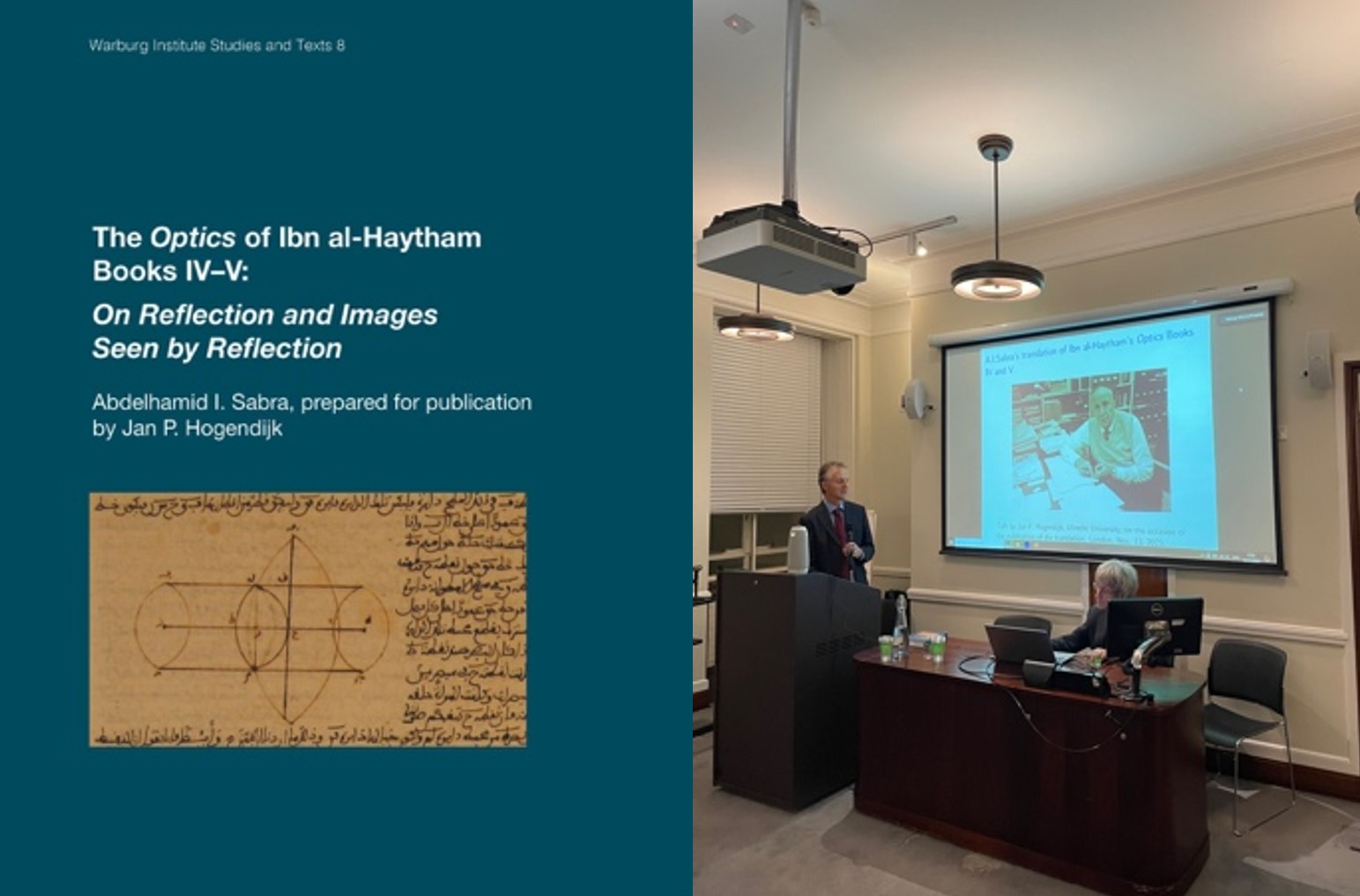
On Monday 13 November 2023, a book launch was hosted by the Warburg Institute, London, for The Optics of Ibn al-Haytham Books IV-V: On Reflection and Images Seen by Reflection, translated by Abdelhamid I. Sabra…
The film is part of a global educational campaign launched by 1001 Inventions in partnership with UNESCO in 2015 that has engaged more than 30 million people around the world.
Ibn al-Haytham (d. 1040) was a Muslim polymath specializing in mathematics, astronomy and physics. He made remarkable contributions to the principles of optics, vision and light. His most outstanding book was “Book of Optics”, which…
Author Bradley Steffens was interviewed by IHR Director Nadeem Haque on August 25, 2017. Steffens is a poet, a novelist, and an award-winning author of more than forty nonfiction books for children and young adults.…
This website uses cookies to improve your experience. We'll assume you're ok with this, but you can opt-out if you wish. Cookie settingsACCEPT
Privacy & Cookies Policy
Privacy Overview
This website uses cookies to improve your experience while you navigate through the website. Out of these cookies, the cookies that are categorized as necessary are stored on your browser as they are as essential for the working of basic functionalities of the website. We also use third-party cookies that help us analyze and understand how you use this website. These cookies will be stored in your browser only with your consent. You also have the option to opt-out of these cookies. But opting out of some of these cookies may have an effect on your browsing experience.
Necessary cookies are absolutely essential for the website to function properly. This category only includes cookies that ensures basic functionalities and security features of the website. These cookies do not store any personal information.