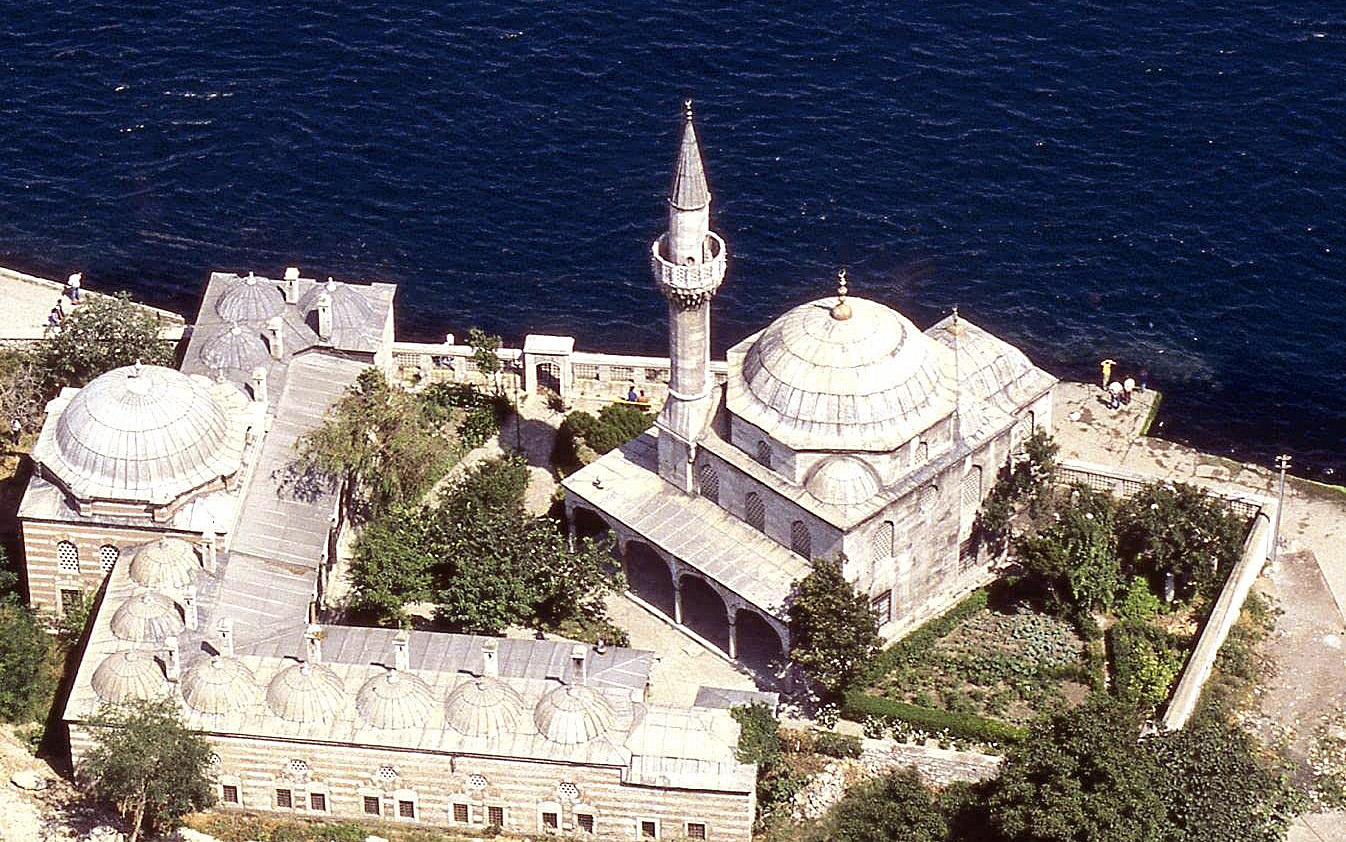
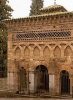
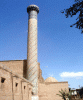
Mimār Koca Sinān, the "Great Architect Sinān", was born in [Ağırnas, Istanbul] Anatolia, Turkey in 1489; he died in Istanbul in 1588. Generally considered the greatest of all Ottoman architects, Sinān's career spanned about fifty years since he was appointed chief royal architect to the Ottoman court by Sultan Suleyman I in 1539. His great mosques are the archetypal image of Turkish Ottoman architecture.
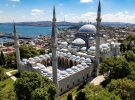
Figure 1. The Şehzade Mosque from Gülru Necipoglu’s book “The Age of Sinan”
During his long career, Sinān built hundreds of buildings including mosques, palaces, harems, chapels, tombs, schools, almshouses, madrassahs, caravanserais, granaries, fountains, aqueducts and hospitals.
Figure 2. Possibly Mimar Sinan (left) at the tomb of Suleiman the Magnificent, 1566 (Source)
Of this diverse group of works, his mosques have been most influential. In his mosques’ design, Sinān exerted his inventive experimentation with centralized domed spaces, often compared with parallel developments in Renaissance Italy, produced monuments in which the central dome appeared weightless and the interior surfaces bathed in light. He often designed his mosques as part of a complex comprising schools, baths, guesthouses and hospitals.
The life story of Sinān is somewhat complex and full of uncertainties. The successful career of this great architect and his genius have prompted great interest among historians of architecture and of Muslim civilisation in the Ottoman period. Some of these scholars constructed his life story linking it very much to his Christian origin. As narrated in these sources, the story consists of the following.
Sinān was the son of Greek Orthodox Christian parents. His father was a stonemason and a carpenter from Greece, or Serbia, or maybe Austria.[1] His mother, according to Egli[2], was imprisoned and then enslaved by Ibrahim Pasha. Sinān learnt his father’s trade in his youth but he was snatched from his family and taken to work for the Caliph court. With the skills learnt at an early age, he quickly developed his career as an architect from his military service at the Janissary Corps. Such a tale is repeated in several recent historical sources.[3] On one of these fabricated tales of Sinān’s origin, put forward by Egli, Goodwin wrote:
“Egli, who has peered diligently into the stews of myth, and rendered a service by so doing, permits himself to fabricate a new account of Sinān’s mother in captivity, the prisoner and slave of Candarli Ibrahim Pasha. This enables him to suggest that Sinān might have been of Greek, Serbian, Albanian or even Austrian, origin”.[4]
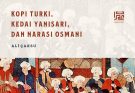
Figure 3. Mimar Sinan ve Tezkiret-ül Bünyan “Şömizli” by Metin Sözen (Source)
To bring a balanced approach to the real-life of this astonishing personality, one has to dig into Turkish sources which consist mainly of his personal biography written by his friend of youth Sai Mustafa Celebi, Tezkiret ül Bünyan as well as Tezkiret ül Ebniye. The third text Tuhfet ül Mimarin was compiled in 1590 and all of them were published by Kuran[5]. However much of what is contained in these sources were inventories of Sinān’s construction projects and therefore many aspects of his real-life are still somewhat mysterious. A recent paper published by Dogan Kuban[6] in the encyclopaedic work of a team of Turkish academics, sheds some light on this incredible personality.
Sometimes in the 15th century Ottoman Caliphate, a Greek Christian embraced Islam and became known as ‛Abd al-Mannān[7], the servant of the Bestower. According to Tezkiret ül Bünyan,[8] ‛Abd al-Mannān chose this name in praise of God who made him a Muslim. He was a stonemason and a carpenter[9] living at Kayseri, central Anatolia. On April 15, 1489 ‛Abd al-Mannān was granted a baby son whom he called Sinān.
From an early age, Sinān followed his father footsteps and learnt the skills of his trade. When he reached twenty-one years of age, he was recruited by the Devshirme into the Janissary Corps within the reign of Sultan Selim I (1512-20). The Devshirme system relied on recruiting young people between the age of 12 and 22 to be trained to become the elite guard and civil servants of the Ottoman Caliphate.
Figure 4. Mimar Sinān on an old Turkish banknote. (Source)
As part of the procedure of this tradition, these youths were carefully considered according to their capabilities. The best of them were selected to work in the Sultan’s Palace in Istanbul or Edirne where they were given special training in various aspects of the Ottoman administration to become a future military or political elite. Those who showed ability in the religious sciences were directed towards religious professions while those proficient in arts were prepared for a career in arts and literary professions.
Figure 5. Gürkan Uygun as Mimar Sinan in the popular Turkish TV Series Muhtesem Yuzyil (Source)
When he was a conscript (acemioğlan), Sinān mentioned that he was willing to learn carpentry.[10] Kuban suggested that Sinān built ships, wooden bridges and probably all sorts of temporary wooden constructions. These skills were further developed during his military service as he participated in a number of Ottoman campaigns including Belgrade (1521), Vienna (1529) and as far as Baghdad (1535).[11]He distinguished himself, particularly, in the campaigns of Belgrade and Rhodes (1522), showing bravery and steadfastness that he was promoted to zenberekdji bashi, a chief firework operator.[12]
In 1534, Sinān participated in the Persian war and showed great effective skills in the battle of Lake Van when he devised ferries for the crossing of the army through the lake. In another campaign, at Wallachia (now Romania), Sinān built a bridge across the Danube for the crossing of the army. This brought him fame and admiration, promoting him to be the chief of military constructions and expanding his carpentry skills to masonry. He gained great experience from this having the opportunity to build or repair bridges, defences and castles. Since then, his talent attracted the Ottoman Sultans who took him as their chief architect for the construction of mosques, schools and other civic buildings.
To sum up, what we know about Sinān’s origins, all the information gathered so far reveals that he had Christian relatives in the villages of the Kayseriye Sanjak that belonged to the Karaman province. It can be argued that the most frequently mentioned village Agirnas, could be the village of Sinān, where he built later a fountain. The exact date of Sinān’s birth, who had been recruited from among the Christian villagers of Central Anatolia before 1520, is not known. Therefore, the common belief that he lived for more than a hundred years is not justified.[13]
[1] See E. Egli (1954), Sinan, der Baumeister osmanischer Glanzzeit, Zurich. [2] Ibid. [3] See for example Encyclopaedia of Islam (1997), Brill: Leiden, vol. 6, pp. 629-630 and “Sinan”, Encyclopædia Britannica (2007). [4] G. Goodwin (1987), A History of Ottoman Architecture, London, p. 197. [5] A. Kuran (1987), Sinan: The Grand Old Master of Ottoman Architecture, Washington, D.C./Istanbul. [6] D. Kuban (2000), “Sinan”, Cicek Kemal, (ed.), The Great Ottoman Turkish Civilisation, Ankara, pp-450-463. [7] Encyclopaedia of Islam (1934), Leiden: Brill, vol. 7, pp.428-432. [8] Reported by Godwin (1987), op.cit., p. 199. [9] “Sinan” in Encyclopædia Britannica (2007). [10] Kuban, D. (2000), op., cit., p.451. [11] Encyclopaedia of Islam (1997), Brill, Leiden, vol. 6, p.629. [12] Encyclopaedia of Islam (1934), op., cit., p. 428. [13] See Dogan Kuban, “Sinan”, in The Great Ottoman-Turkish Civilization, vol. IV, ed. K. Cicek et al., Ankara: Yeni Turkiye, 2000, pp. 450- 463; Esin Atil, “Art and Architecture”, in History of the Ottoman State, Society and Civilization, ed. E. Ihsanoglu, Istanbul: IRCICA, 2002, pp. 607-644; Gülru Necipoglu, The Age of Sinan: Architectural Culture in the Ottoman Empire. London: Reaktion Books, 2005.
This article has been extracted from Dr Rabah Saoud’s article “Sinan: A Great Ottoman Architect and Urban Designer“, June 2007 and updated from the old article dating back to 03/06/2007. This article and images on a topic covered within this website muslimheritage.com. The author of the article is responsible for the accuracy of the facts. The third-party images do not belong to this website. Images have been chosen by the Muslim Heritage Editorial Team, accordingly to the topic, with their main source supplied in their captions below the images. If you have any objections to seeing this story on this website, please contact us.
Figure 7. Imaginary drawing of Mimar Sinan (Source)
This website uses cookies to improve your experience. We'll assume you're ok with this, but you can opt-out if you wish. Cookie settingsACCEPT
Privacy & Cookies Policy
Privacy Overview
This website uses cookies to improve your experience while you navigate through the website. Out of these cookies, the cookies that are categorized as necessary are stored on your browser as they are as essential for the working of basic functionalities of the website. We also use third-party cookies that help us analyze and understand how you use this website. These cookies will be stored in your browser only with your consent. You also have the option to opt-out of these cookies. But opting out of some of these cookies may have an effect on your browsing experience.
Necessary cookies are absolutely essential for the website to function properly. This category only includes cookies that ensures basic functionalities and security features of the website. These cookies do not store any personal information.