Bursa , famous for its historic hammams (Turkish Baths), juicy peaches, succulent kebabs, rich silk and textile production, vibrant markets, and Iznik tile‑adorned architecture, making it a city where culinary, cultural, and artistic traditions intertwine. Bursa, the first capital of the Ottoman Empire, conquered by Orhan Gazi in 1326, was more than just a political center, it was a vibrant hub of science, culture, and learning. Strategically located along trade routes connecting Anatolia, the Balkans, and the Silk Road, the city became a crossroads for scholars, ideas, and innovations from across the Islamic world. From the Yıldırım Darüşşifası (Yıldırım Beyazıt Hospital) to the iconic Ulu Cami and Yeşil Cami, Bursa combined education, medicine, and architectural brilliance. It was home to remarkable figures like Somuncu Baba and Aziz Mahmud Hüdayi, while also nurturing cultural treasures such as silk carpets and the Karagöz and Hacivat shadow puppetry. Bursa’s rich legacy as a center of knowledge and creativity laid the foundation for the flourishing Ottoman Empire and continues to inspire admiration today.
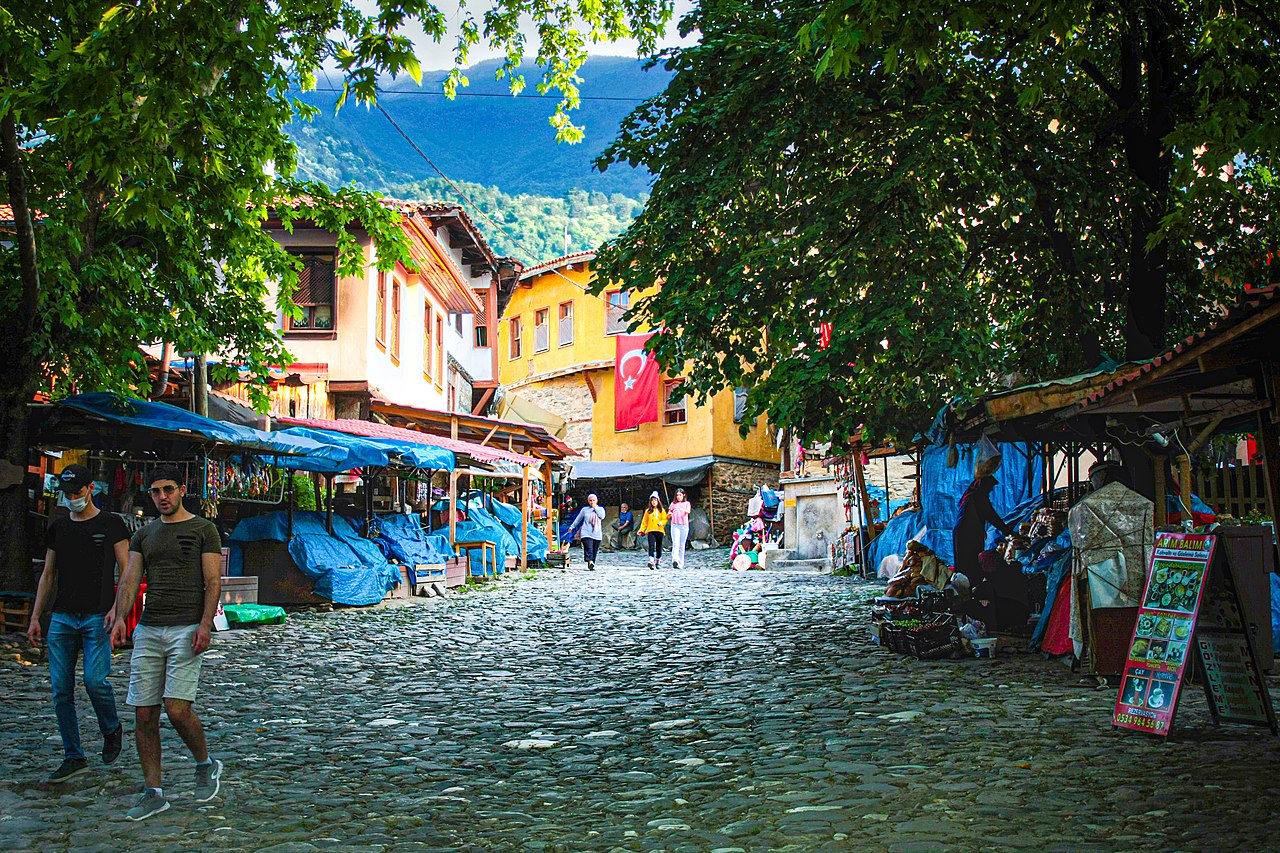
Figure 1. Renovated Ottoman houses in Bursa, Turkey (Wikipedia)
***
Editor’s Note: First written in late 2021 and last updated and expanded in August 2025 by Cem Nizamoglu.
***
The Green City: Where Empires Flourished
From the days of Hannibal to the ancient Greeks and Romans, the city was known as Prusa, located in Bithynia (see Appendix VII & IX). In Turkish, however, it is more often referred to as “Yeşil Bursa” (Green Bursa), a name evoking its lush parks, gardens, and the dramatic backdrop of Mount Uludağ.[01] The city has long been celebrated not only for its natural beauty but also for its Ottoman horticultural heritage. It became a renowned centre of silk production, a craft that greatly enhanced its prestige in both regional and imperial contexts.[02] Bursa, the first capital of the Ottoman Empire and now Turkey’s fourth-largest city, has a history stretching back to around 5200 BCE. Over the millennia, it has been home to the Greeks, Bithynians, Romans/Byzantines (see Appendix V), and Ottomans, each of whom has left enduring cultural and architectural imprints on the city’s fabric.[03]
Figure 2. Portrait of Orkhan Ghazi drawn by the Venetian painter Paolo Veronese, 1553 (Wikipedia)
Among its most iconic landmarks are the Iznik-tile‑decorated mausoleums, most notably the Green Tomb (Yeşil Türbe), the final resting place of Osman I and his son Orhan, the empire’s founders. [04] Today, Bursa blends history and modern life, offering visitors a travel experience rich in culture, beauty, and enduring charm. Conquered by the Ottomans under Orhan Gazi in 1326 (see Appendix I), it swiftly became a centre of political, cultural, and scientific activity. [05] Its strategic position on trade arteries to Anatolia, the Balkans, and the Silk Road facilitated exchanges of ideas, manuscripts, and scholars from Islamic centres such as Baghdad, Damascus, and Córdoba. [06]
The surrounding region equally exemplifies Bursa’s rich heritage. Mudanya, a coastal town on the Sea of Marmara, preserves Ottoman-era architecture and played a role in the Turkish War of Independence, especially the Armistice of Mudanya. [07] The UNESCO-listed village of Cumalıkızık maintains its early Ottoman rural character, with cobblestone streets and timber-framed architecture. [08] Gölyazı, a lakeside town situated on Lake Uluabat, boasts scenic charm and a fishing tradition dating back to Roman/Byzantine times. [09] Karacabey is renowned for its fertile agricultural plains, while Orhaneli boasts lush forests and a traditional Ottoman village atmosphere. [09] Together, these towns and villages reflect a harmonious blend of history, culture, and natural beauty.
And of course, let’s not forget the Döner Kebab (see Appendix VI).
Figure 3. The village of Cumalıkızık, near Bursa, is a UNESCO World Heritage Site with Ottoman-era historic houses. (Wikipedia)
The City of Learning: Where Education Flourished
Figure 4. Tiled mihrab (a niche in the wall of a mosque, at the point nearest to Mecca, towards which the congregation faces to pray) of the Green Mosque in Bursa (early 15th century) (Wikipedia)
Bursa also gained recognition for its innovations in textiles and architecture. The city’s silk production and carpets were highly valued, enhancing the prestige of palaces and mosques throughout the empire. [10, 11]
One notable example is the tiled mihrab of the Green Mosque in Bursa (early 15th century), a niche indicating the direction of Mecca for prayer. [12]
Bursa is also known as “medrese şehri” (city of madrasas), which roughly translates to a city of learning. Architecturally, landmarks such as the Grand Mosque (Ulu Cami, 1396–1399) and the Green Mosque and külliye (Yeşil Cami, 1419–1421) demonstrate a synthesis of Eastern Roman (Byzantine – see Appendix V) and Islamic traditions, notable for expansive domes, intricate tilework, and broad courtyards. [13, 14] These buildings exemplify early Ottoman architectural styles and highlight the period’s advanced engineering and artistry. [14]
The Green Mosque (Yeşil Camii), built under Sultan Mehmed I, is a striking example of early Ottoman architecture and a centrepiece of a larger külliye (complex – see Appendix IV). [12, 15] Located on the east side of the city, the mosque is part of a multifaceted complex including a türbe (tomb), madrasah (Islamic school), kitchen, and bathhouse, reflecting the Ottoman tradition of integrating religious, educational, and social functions. [15] As Bursa was the first capital of the Ottoman Empire before the conquest of Constantinople in 1453, the Green Mosque exemplifies the city’s historical role as a centre of cultural, architectural, and civic life. [10, 12]
Figure 5. Bursa Green Mosque (Yeşil Cami) – Wikipedia
Image 6 Figure 6. Tophane Meydanı (Square) / Tophane district, where the tombs of Osman and Orhan Gazi are located (the Meydan-ı Osmânî), miniature by Yasin Urhan
Külliye, with its multi-functional approach, enabled Ottoman architects, particularly Mimar Sinan, to design complexes that combined spiritual, educational, medical, and social services within a single urban hub. Conceptually, it is akin to assembling a “collage” of “college” of buildings, each serving distinct purposes, into a cohesive and harmonious whole. (See Appendix VIII)
Culturally, Bursa distinguished itself as a hub for Islamic architecture, education, and the arts. Early madrasas (Islamic schools) offered instruction in medicine, astronomy, and philosophy, drawing extensively on the scholarship of the Islamic Golden Age. Scholars based in Bursa both preserved classical texts by figures such as Al-Razi (865–925), Ibn al-Haytham (965–1040), Al-Biruni (973–1048), Ibn Sina (980–1037), and Nasir al-Din al-Tusi (1201–1274), adapting them for wider dissemination across Anatolia and beyond. [16, 17]
From a scientific perspective, Bursa contributed to the advancement of medical and technical knowledge by integrating classical works with local observations and practices. The city housed the Yıldırım Darüşşifası, built by Yıldırım Beyazit, which was founded in the 14th century as the first Ottoman hospital, Beyazıt/Yıldırım I Darüşşifa (1400), located in the Yıldırım Complex in Bursa. It served as both a medical facility and an educational institution, reflecting the Islamic tradition of combining clinical practice with teaching. [18]
Image 9 Figure 9. The first Ottoman hospital, built between 1390–1394 as part of Yıldırım Bayezid’s külliye in Bursa. Constructed of stone and brick, it features arcades, domed halls, patient rooms with fireplaces, and a minaret with a hexagonal brick shaft and stalactite balcony. (kulturportali.gov.tr)
The City of Muslim Saints: Where Scholars Flourished
Several prominent individuals associated with Bursa contributed significantly to the intellectual and spiritual heritage of the Ottoman Empire, where Bursa is also known as “Evliyalar şehri” (The City of Muslim Saints /Awliyas) [18.a]:
Molla Fenârî (Shams al-Dīn al-Fenârī, 1350–1431) was a pioneering figure in early Ottoman scholarship, serving as the first official Şeyhülislam, qadi, and head of Bursa’s Manastır Madrasa. Known for harmonising logic, theology, and mysticism, Fenârî taught and preached in Bursa:
“If the heart is deprived of wisdom for three days, it dies. The fruit of knowledge is that it brings its possessor closer to the Lord of the worlds.”[19]
Üftade Hazretleri (1490–1580) was one of Bursa’s most influential Sufi masters, renowned for humility and asceticism. Born in Bursa, he initially worked as a muezzin and later became an imam. His reputation for wisdom attracted students, including Aziz Mahmud Hüdayi, later a prominent Ottoman saint. Üftade’s teachings emphasised detachment from worldly ambitions and remembrance of God, preserved in poetry and oral tradition:
“He is the nightingale of the garden of love; he is the healer of troubled lovers, his eminence is Üftade.”[20]
“Bâğ-ı aşkın andelîbi, hazret-i Üftâde’dir. Dertli aşıklar tabîbi, hazret-i Üftâde’dir.” Üftade – Original Full Text
Aziz Mahmud Hüdayi (1541–1628) was a prominent Ottoman Sufi saint, scholar, and poet. Born in Şereflikoçhisar and later settling in Istanbul, he initially served as a kadı in Bursa before meeting his spiritual guide, Üftade Hazretleri. He went on to establish the Celvetiyye Sufi order, attracting disciples from all walks of life, including Ottoman sultans. Hüdayi’s poetry explored divine love and surrender to God:
“Who seeks loyalty from you, O fleeting world? Are you not but a realm of deceit? You even claimed the Master of all Prophets; is this not the truth of what you are?” [21]
Somuncu Baba (Sheikh Hamid-i Veli, c. 1331–1412) was a revered Sufi master and spiritual guide. Settling in Bursa during Sultan Bayezid I’s reign, he became known for humility, selling bread while concealing vast knowledge. He played a key role in the spiritual inauguration of the Grand Mosque (Ulu Cami), delivering its first Friday sermon. His teachings emphasised inner purification, modesty, and service to others:
“The heart is the Kaaba of God; do not break it, but rebuild it with love.”[22]
Süleyman Çelebi (c. 1351–1422) was imam of the Grand Mosque and author of the Mevlid (Vesîletü’n-Necât, 1409), a long devotional poem praising the Prophet Muhammad. Written in Bursa, the Mevlid preserved Turkish in religious expression and became a cornerstone of Ottoman devotional culture. [23, 24]
“Jesus died not, but found the path on high, that he might be of that blest company. And Moses’ rod within his hallowed hand, for His great honour turn’d to serpent grand. Full many pray’d of God with heart’s desire, that they might join Muhammed’s noble choir. Though these were also prophets sent of yore, yet Ahmad shineth brighter, evermore. For he alone is meet for chiefest grace, who knoweth not is a fool in every place.”(Turkish)
İsmail Hakkı Bursevî (1653–1725) was a major Ottoman Sufi scholar, commentator on Ibn Arabi, and head of the Celvetiyye order in Bursa. Author of over 100 works, including Rûhu’l-Beyân, he blended orthodox scholarship with mystical insight. Bursevî emphasised humility in worship:
“One who wishes to reach the Truth must cleanse his heart from everything other than God.” [25]
Figure 10. Ottoman Miniature: Capital Bursa Poster by ersindesign (redbubble.com)Bursa’s role as a political, commercial, and spiritual centre is reflected in the enduring legacy of these scholars, whose teachings and writings continue to inspire visitors and students in both Bursa and Istanbul. [26]
Mimar Sinan (c. 1489–1588), the chief imperial architect of the Ottoman Empire under sultans Süleyman the Magnificent, Selim II, and Murad III, is celebrated as one of the greatest architects in history. Although his most famous works are in Istanbul, Edirne, and other major cities, Bursa holds a special place in his architectural journey as an apprentice. Bursa, with its rich architectural heritage, was both an inspiration and a canvas for Sinan. While he did not design the city’s early Ottoman monuments, such as the Green Mosque or the Grand Mosque, he worked on important restoration and expansion projects, particularly strengthening and renovating mosques, bridges, and public baths. His designs respected and enhanced the city’s earlier architectural traditions, blending classical Ottoman forms with the city’s lush, mountainous backdrop. One notable example is his work on the Muradiye Complex, where he oversaw restoration efforts that preserved the original 15th-century character while improving structural durability. Sinan’s understanding of harmony between built space and natural surroundings resonated with Bursa’s character, reinforcing the city’s status as a jewel of Ottoman architecture. As Sinan himself wrote in his memoirs, Tezkiretü’l-Bünyan:
“Her yapıda önce mekânın ruhunu duymak gerekir.” (“In every building, one must first feel the spirit of the place.”)[27]
Through both his direct contributions and the influence of his style on later Bursa architects, Sinan helped ensure that the city remained not only a historic capital but also a living museum of Ottoman architectural excellence. (See Appendix IX)
Evliya Çelebi (1611–1682), born in Istanbul, was an Ottoman explorer, writer, and scholar best known for his ten-volume travelogue, the Seyahatname (Book of Travels). During his extensive travels across the Ottoman Empire, he documented cities, architecture, social customs, and scholarly life, including Bursa. Çelebi highlighted Bursa’s historical mosques, madrasas, markets, and medical institutions, emphasising its significance as a cultural, religious, and scientific centre. His writings provide valuable insight into Bursa’s urban planning, education system, medical practices, and commercial life, including silk production and carpet weaving. He considered Bursa not just a city, but a central jewel of Ottoman heritage, richly populated, welcoming, and culturally diverse:
“This lower city lies on flat land; the houses, imarets, and Ulu Cami at the foot of the citadel are built on high ground. When viewed from Filedar Plateau, in the north, the city shines like sky-colored lead, illuminated like fire under the sun. Inns, baths, mosques of sultans, charitable institutions, and covered bazaars shine in layers… this great city, unlike all others, is radiant under light; it is a venerable, heavenly place.”[28]
“In the southern part of the city, on Monk Mountain, there are 1,060 known life-water springs of various names and forms, flowing in channels to homes and palaces, supplying the city. Its wide province is well-tended; vineyards and gardens are famed, this is a city like heaven that will endure forever.” [28]
After departing Istanbul, Çelebi begins his journey in Bursa, calling it:
“the land of silk, a great city, vibrant and venerable, God’s prayerful place, the throne of states, and the former Ottoman capital.” [29]
He composed the second volume of his travels, starting with Bursa, describing its diversity of neighbourhoods:
“…176 Muslim, 7 Armenian, 9 Greek, 6 Jewish, and even one community of Copts and another of the poor living near Muradiye Road.”[29]
Figure 11. Mosaic Wall Tile Work, Kurşunlu Street, Tahtakale, Bursa – Wikipedia
Although Matrakçı Nasuh (1480–1564), the celebrated Ottoman polymath, miniature artist, and mathematician, created exquisite illustrated maps of many Anatolian cities in his Beyan-ı Menazil-i Sefer-i Irakeyn, no confirmed miniature of Bursa is known to exist. While nearby İznik (Nicaea) appears in his depictions, Bursa itself is absent from the extant manuscripts. This absence is intriguing, given Bursa’s importance as the first Ottoman capital, and has led scholars to suggest that lost or incomplete works may once have contained such a depiction. Nonetheless, Matrakçı’s cartographic style, combining geographic precision with artistic elegance, remains a vital lens through which to imagine how Bursa might have been represented in the Ottoman imagination.
His illustrations, had Bursa been included, would likely have documented the city’s mosques, madrasas, markets, baths, gardens, and overall urban layout, providing an invaluable historical record of its appearance during the early 16th century as a cultural and commercial centre. Matrakçı’s style blends scientific precision with artistic elegance, embodying the Ottoman tradition of merging cartography with miniature painting, ensuring that the city would have been immortalised as a visual memory of its prosperity. [30]
Although Ahmed Yesevî (Aḥmad Yasawī d. 1166), the celebrated Sufi master of Turkistan, never personally visited Anatolia, his spiritual legacy reached the region through his disciples and later orders. This influence was felt indirectly through early frontier saints (abdalān al-rūm) such as Geyikli Baba, Abdal Murad, and later Emir Sultan, who embodied elements of the Yesevî tradition in their asceticism, poetry, and role in sanctifying Ottoman rule. The tekkes (Sufi lodges) established in and around Bursa became vital centres of spiritual and social life, where Yesevî-inspired practices were transmitted and adapted.[30a]
Just as Aḥmad Yasawī’s teachings shaped the religious mindset of early Turks, Kâşgarlı Mahmud (Maḥmūd al-Kāshgharī d. 1102), a scholar from Kashgar, is renowned for his Dīwān Lughāt al-Turk (Compendium of the Languages of the Turks). This linguistic and cultural work laid the intellectual foundations for Turkic identity, emphasising the richness of Turkic speech and poetry.[100] Centuries later, in Bursa, the Ottomans carried forward this linguistic and cultural legacy, blending Turkic traditions with Islamic and Persianate influences.[101]
Several early Ottoman scholars and figures were instrumental in Bursa’s intellectual, spiritual, and architectural development during the 15th and 16th centuries:
Hacı Paşa (d. early 15th century) – An early Ottoman scholar and physician, known for his work in Bursa’s medical institutions, including the Yıldırım Hospital, contributing to the integration of medical practice and education. [31]
Aziz Mahmud Hüdayi (1541–1628) – Prominent Sufi and spiritual leader of the Celvetiyye order, active in Bursa, whose teachings influenced the city’s spiritual and intellectual life. [32]
Mehmed Efendi of Bursa (16th century) – Scholar and historian; contributed to Ottoman historiography, documenting the city and its institutions. [33]
Kadı Seyyid (late 15th–early 16th century) – Jurist and scholar involved in education and administration in Bursa, helping structure legal and scholarly institutions. [34]
Hacı Taşan Efendi (16th century) – Architect and engineer who worked on early Ottoman constructions in Bursa, contributing to city planning and architectural innovation. [35]
Through their combined efforts, Bursa emerged as a vibrant centre of learning, spirituality, and architectural achievement, further underlining its historical importance beyond its political role as the first Ottoman capital.
Figure 14. The courtyard of the Koza Hanı (inn of the silk cocoon), a historic caravanserai (han) in Bursa, Turkiye. It is located in the heart of the city’s historic market district, with the mescit (small mosque) at its centre – Wikipedia
City with Golden Past
While Bursa more often served as a transmitter and hub for knowledge rather than as the birthplace of most classical Islamic scientists, it hosted and connected many scholars during the Ottoman era. Additionally, Bursa played a critical role in preserving and circulating seminal works from the Islamic Golden Age:
Image 15Figure 15. A poster of the International 7 Saints 7 Cities Short Film Festival. – Anadolu Agency (AA)
Ibn Sina (Avicenna, 980–1037): His Canon of Medicine had a profound influence on Ottoman physicians and was studied in the Bursa madrasas. [36]
Al-Razi (Rhazes, 865–925): His treatises on smallpox, measles, and general medicine were maintained and taught in facilities such as the Yıldırım Hospital. [37]
Ibn al-Nafis (1213–1288): Discoverer of pulmonary circulation; his works featured in Ottoman medical education. [38]
Süleyman ibn Abdullah: A 15th-century Ottoman physician affiliated with Bursa’s medical institutions. [39]
Taqi al-Din (1526–1585): Ottoman astronomer, engineer, and mathematician, whose legacy was integral to Bursa’s observatories and madrasas. [40]
Ali Qushji (1403–1474): Mathematician and astronomer referenced in Bursa madrasas after arriving from Samarkand. [41]
In addition to resident scholars, travellers like Ibn Battuta documented Bursa during his famous 14th-century journeys. When he came to Anatolia around 1331–1333, Bursa was a relatively new Ottoman capital under Orhan Gazi. In his Rihla (travel account), Ibn Battuta described Bursa as a beautiful, prosperous city with fine markets, baths, and gardens. He praised its thermal springs, noting the separate facilities for men and women and the hospices where patients stayed for several days. He also highlighted Bursa’s political and economic significance:
“We journeyed next to Bursa [Brusa], a great city with fine bazaars and broad streets, surrounded by orchards and running springs. Outside it are two thermal establishments, one for men and the other for women, to which patients come from the most distant parts. They lodge there for three days at a hospice which was built by one of the Turkmen kings.”[42]
Ibn Battuta also emphasised the city’s ruler:
“The sultan of Bursa is Orkhan Bek, son of Othman Chuk… the greatest of the Turkmen kings and the richest in wealth, lands and military forces.” [42]
In summary, Ibn Battuta described Bursa as:
“a great and important city with fine bazaars and wide streets, surrounded on all sides with gardens and running springs.”[42]
Bursa’s position as a political, commercial, and intellectual hub allowed it to connect Anatolia with the wider Islamic world, facilitating the transmission and preservation of knowledge from the Islamic Golden Age.
Image 16 Figure 16. A modern adaptation of the Bursa Map in Ottoman Style by Architecvs
Conculusion
In summary, Bursa functioned as a bridge between the Islamic Golden Age and the Ottoman Empire, ensuring the preservation, transmission, and evolution of scientific, medical, architectural, and cultural knowledge.[43] The city’s achievements in medicine, textiles, architecture, and education illustrate its pivotal contribution to the intellectual and artistic legacy celebrated by the International 7 Saints 7 Cities Short Film Festival.[44]
Throughout Islamic history, scientific and cultural development flourished, particularly during the Islamic Golden Age (8th–14th centuries), which witnessed remarkable advancements in mathematics, astronomy, chemistry, physics, and medicine.[45] Centres such as Baghdad’s House of Wisdom became renowned for translating and expanding upon Greek, Persian, Indian, and Roman works. [46] Scholars like Al-Khwarizmi introduced algebra, while Al-Haytham revolutionised optics.[47] In the arts, calligraphy, poetry, and music thrived, influencing not only Islamic society but also Europe and Asia.[48] This profound commitment to inquiry and creativity laid the groundwork for subsequent innovation, echoed in Bursa’s vibrant role as a conduit and conservator of this heritage [49]. The city thus embodies the enduring significance of interconnected centres that propelled progress throughout the Islamic world.
Figure 17. Bursa Conquest Miniature (illuminated manuscript), 1326 (Source)
Appendix I – Orhan Gazi
Orhan Gazi (c. 1281–1362) was the second ruler of the Ottoman Beylik (principality), succeeding his father, Osman I, and his grandfather Ertuğrul.[50] His reign, from 1326 to 1362, marked a crucial period in Ottoman expansion, including the conquest of Bursa in 1326, which became the first Ottoman capital.[50]
The word “ghazi” comes from the Arabic “ghazw,” meaning a raid or military expedition. At first, it described the campaigns of Prophet Muhammad, but later Turkic warriors on the frontiers of Anatolia adopted the title as a badge of honour. For the Ottomans, being a ghazi wasn’t just about fighting; it carried spiritual weight too, framing their conquests as part of a sacred mission against enemies of Islam or their nation. That’s why early leaders like Ertuğrul and Osman I proudly used the title. Even today, in Turkish, “gazi” is used to mean a veteran, keeping that long tradition alive. [50a]
Orhan Gazi is known for establishing foundational administrative and military structures of the early Ottoman state, consolidating power in northwestern Anatolia, and fostering urban and cultural development.[51] Under his rule, Bursa became a hub of trade, architecture, education, and religious institutions, laying the groundwork for the city’s later role in preserving and transmitting Islamic Golden Age knowledge.[51]
He also encouraged cultural activities and innovations, indirectly giving rise to traditions such as Karagöz and Hacivat shadow puppetry, reflecting the blend of entertainment, social commentary, and education that characterised early Ottoman society.[52]
Orhan Gazi, the second ruler of the Ottoman Beylik, significantly expanded the principality’s territorial holdings, increasing its area sixfold to approximately 95,000 square kilometres.[53] During his reign, the population grew from around 3,000 to nearly 3 million, reflecting both the stability and attractiveness of his administration.[53] Orhan Gazi supported a standing army of 40,000 soldiers, which could be expanded to 100,000 during military campaigns, ensuring both defence and territorial expansion.[54] Beyond military achievements, he actively promoted governance in collaboration with scholars, fostering education, religious institutions, and cultural life.[54] Christian communities, weary of the oppression of their previous rulers, often sought refuge under his just administration, highlighting the inclusivity and appeal of his governance.[55] Through these political, military, and cultural strategies, Orhan Gazi transformed a small principality into the foundation of a lasting and expansive state.[55]
Karagöz and Hacivat are legendary shadow puppetry characters who originated in Bursa in the early 14th century, around the 1320s–1330s during the reign of Orhan Gazi.[56] The tradition of shadow play, known as Karagöz ve Hacivat, evolved into a popular form of entertainment and social commentary, blending humour with lessons on morality, culture, and daily life.[56]
Bursa today honours this cultural heritage with a dedicated museum, the Karagöz and Hacivat Museum, which preserves puppets, scripts, and historical records of performances.[57] The puppetry tradition reflects the city’s broader role as a cultural hub, where arts, literature, and oral storytelling flourished alongside advancements in science and education.[57]
Figure 17. The PTT administration issued two series of Karagöz-themed stamps. The top row features two stamps from the 1967 “Tourism Year” series, depicting Karagöz and Hacivat. The bottom row features three stamps from the 2007 “Our Cultural Heritage” series, depicting Hacivat, Karagöz, Tuzsuz Deli Bekir, Efe, Tiryaki, and Çelebi. – Vikipedia
Cem Sultan (1459–1495), son of Mehmed the Conqueror, has a notable connection to Bursa.[59] In 1481, following his father’s death, Cem Sultan declared himself Sultan of Anatolia in Bursa, establishing the city as his temporary capital.[59] During his brief reign, he minted coins and issued decrees under his name.[60] However, his brother Bayezid II swiftly mobilised forces, defeating Cem’s army near Yenişehir and forcing him into exile.[59] After spending years in captivity across Europe, Cem Sultan passed away in Naples in 1495.[61] His body was later returned to Bursa, where he was interred in the Muradiye Tombs, alongside other Ottoman princes.[62]
Today, Cem Sultan’s tomb stands as a significant historical site in Bursa, reflecting the city’s pivotal role in the early Ottoman Empire’s political and dynastic developments.[62]
Cem Sultan is celebrated not only for his tumultuous political life but also for his contributions to Ottoman literature.[62] Exiled to various European courts, Cem immersed himself in Persian literary traditions, drawing inspiration from poets such as Nezami, Ḥāfeẓ, and Jami.[62] His poetry, composed in Persian and Ottoman Turkish, reflects themes of longing, mysticism, and the human condition.[62] A notable example from his Divan (collection of poems) is:
“In the garden of the heart, the rose of love blooms; Without the wine of passion,
the soul remains parched.”[63]
This couplet exemplifies Cem’s adeptness at blending classical Persian poetic forms with the Turkish literary landscape.[62] His works not only enriched the cultural tapestry of the Ottoman court but also played a pivotal role in the transmission of Persian literary heritage to the West.[62] Through his poetry, Cem Sultan remains a testament to the enduring power of art in bridging cultures and eras.[63]
Among Ottoman sultans who composed poetry, Cem Sultan is considered one of the most accomplished in expressing personal emotions through verse. From an early age, the prince engaged deeply with literature and poetry, cultivating a circle of poets around him known as the “Cem Poets.”[63] This group included prominent contemporary poets such as Cem Sadisi, Haydar Bey, Sehâî, Kandî, and Şâhidî, some of whom continued to support Cem even during his years in exile.[64]
Cem Sultan’s poetry reflects the trials and sorrows he experienced, conveyed with remarkable emotional depth.[63] Notably, he composed Fal-i Reyhan, a 48-couplet poem in the form of a floral divination. He also compiled two Divans, one in Persian and one in Ottoman Turkish, as well as a mesnevi entitled Hüsrev ü Şirin.[63] His Divans are suffused with a pervasive sense of melancholy, revealing the prince’s introspective and sensitive nature.[65]
“Bird of my soul, be patient of thy cage, This body, lo! How fast it wastes with age. The tinkling bells already do I hear Proclaims the caravan’s departure near. Soon shall it reach the land of nothingness, And thee, from fleshy bonds delivered, bless.” [66]
Figure 18. Mehmed and His Son, a painting by Gentile Bellini, believed to depict Mehmed II and his son Cem Sultan (Wikipedia)
Appendix IV – Külliye or college
The concept of a külliye, a complex centred around a mosque that includes multiple charitable, educational, and social institutions, is architecturally and socially inspired by earlier Islamic, Roman/Byzantine, and Persian models of integrated civic-religious complexes, which can be described as “collages” (kolej in Turkish) of functions. [67]
A typical külliye includes: • A mosque, • A madrasa (school), • A darüşşifa (hospital), • A soup kitchen (imaret), • Bathhouses (hammams), • Caravanserais or markets.
Although the terms külliye and college come from different linguistic roots, some scholars propose a historical and conceptual link. Külliye derives from the Arabic root kull (meaning “all” or “entire”), emphasising the integration of spiritual, educational, medical, and social functions within a single institution. [68] The English word “college” comes from the Latin “collegium,” meaning “community” or “gathering,” referring to a group of people united for study or a shared purpose. [69]
The conceptual connection between the two arises from the role of Ottoman külliyes as multi-functional hubs of learning, religion, and social service. [70] During the Islamic Golden Age, scholars in centres like Baghdad, Cairo, and Córdoba translated Greek, Persian, and Indian works into Arabic, preserving and expanding classical knowledge. [71] These texts and institutional models were later transmitted to the Ottoman Empire, where madrasas and külliyes became both repositories and teaching centres for this knowledge. [70]
Through Ottoman trade, diplomacy, and scholarly correspondence, European travellers, diplomats, and scholars encountered these multi-functional institutions. [72] Many researchers argue that this exposure, coupled with the broader translation movement from Arabic to Latin in Spain and Italy (12th–15th centuries), influenced the emergence of the modern college in Europe. [70] The college, like the külliye, became a communal institution where education, mentorship, and social functions were integrated, though in a secularised and specialised form. [69]
In this context, the English term college may not be a direct linguistic descendant of külliye. Still, the conceptual inheritance is notable: both institutions embody the principle of bringing people together for holistic education and communal engagement. [70] Ottoman külliyes, as multi-functional centres of learning and social life, arguably helped shape European ideas about institutionalised education, providing a practical model that preceded the rise of Western colleges. [68]
The establishment of Western-style colleges in the Ottoman Empire began in the mid-19th century, during the empire’s period of decline, with Robert College leading the way. [72] These institutions played a crucial role in introducing and integrating Western educational models into the Ottoman-Turkish educational landscape. [73] They were often perceived as instruments of imperialistic influence, and in some perspectives, alternatives to the traditional külliye and madrasa systems. [74] Consequently, certain Islamic movements promoted külliyes over foreign institutions, viewing them as more culturally authentic and resistant to imperialist influence. [74] This emphasis continued through the Ottoman period and into the establishment of the Turkish Republic, reflecting the enduring role of the külliye concept in education. [68] Although Western colleges and universities eventually supplanted madrasas, and the concept of college evolved, the intellectual and social vision of the külliye continues to resonate, illustrating a conceptual and historical link between the two. [70]
Byzantium and the Roman Empire are essentially the same thing, often referred to as the Eastern Roman Empire after the fall of Rome in the West. Byzantium was originally an ancient Greek city located on the Bosporus, founded around 660 BC. In 330 AD, Emperor Constantine I rebuilt it and renamed it Constantinople, which roughly corresponds to today’s Fatih district in Istanbul. While the Western Roman Empire collapsed in the 5th century, the Eastern Roman Empire continued until Constantinople fell to the Ottomans in 1453, so in a sense, the Roman Empire’s so-called Fall of Rome occurred then.
The term “Byzantium” itself is misleading and Eurocentric. It was introduced much later by the historian Hieronymus Wolf in 1555 to distinguish the Eastern Roman Empire from “Rome,” even though its inhabitants considered themselves Romans throughout its existence:
5.1 Byzantium or Rome – Debunking the Eurocentric Myth of the “Byzantine Empire”
When people speak of the “Byzantine Empire,” they usually mean the Eastern Roman Empire, centred on Constantinople from 330 to 1453. Yet, the very term “Byzantine” is misleading. In reality, what we call “Byzantium” was simply the Roman Empire, continued in the East long after the fall of Rome in the West. The name “Byzantine Empire” was never used by its inhabitants and was only introduced much later by European historians for ideological reasons. [75]
5.2 The Romans Who Called Themselves Romans
The inhabitants of Constantinople did not call themselves “Byzantines.” They consistently referred to themselves as Ῥωμαῖοι (Rhomaioi) — Romans — and their state as the Basileía tōn Rhōmaíōn (Empire of the Romans). This was not a symbolic title but a lived identity. Even in the tenth century, Emperor Constantine VII referred to his realm as Romania (Ῥωμανία) in his political treatises. [76]
Language and religion shifted over time, from Latin to Greek and from pagan traditions to Christianity. Still, the imperial self-understanding remained intact: the emperors in Constantinople were Roman emperors, not the rulers of some “other” empire. [77]
5.3 Legal and Institutional Continuity
The Eastern Roman Empire inherited and preserved Roman law, most famously codified in Emperor Justinian’s Corpus Juris Civilis (529–534), which later became foundational for European legal systems. [78] The empire’s political institutions also remained Roman. The Senate of Constantinople, the system of imperial succession, and the very rituals of coronation were all modelled on their Roman predecessors. [79]
This continuity means there is no legitimate historical “break” that would justify renaming the empire. From Augustus to Constantine XI Palaiologos, the Roman line was unbroken. [77]
5.4 The Invention of “Byzantium”
The term “Byzantine Empire” did not exist in the Middle Ages. It was coined in 1555 by the German historian Hieronymus Wolf, who published his Corpus Historiae Byzantinae. [80] Wolf deliberately used “Byzantine”, from Byzantium, the city’s pre-Constantinian name, to distinguish the Greek-speaking Christian empire from the Latin-speaking “ancient” Rome.
This renaming was not neutral. By calling the empire “Byzantine,” Western scholars effectively denied its Roman identity. In the centuries after the fall of Constantinople (1453), Catholic Europe sought to claim the Roman legacy for itself, particularly through the ideology of the Holy Roman Empire. Rebranding Constantinople as “Byzantium” served this agenda by suggesting that Rome had ended in the West in the fifth century. [81]
5.5 A Eurocentric Narrative
The labelling of the Eastern Roman Empire as “Byzantine” reflects a broader Eurocentric bias in historiography. As Anthony Kaldellis argues:
“Nearly every book on the Byzantine Empire begins by noting that its people never called themselves Byzantine. They were Romans, and always called themselves such; theirs was the true and continuous legacy of the Roman Empire…” Byzantine Emporia[82]
By imposing a new name, later historians constructed an artificial division that obscures the empire’s true identity.
Even Edward Gibbon, who devoted much of his monumental Decline and Fall of the Roman Empire to the Eastern Romans, reinforced this distortion by portraying them as degenerate heirs rather than legitimate Romans. [83] His influential framing contributed to the persistence of the myth.
5.6 Conclusion
The so-called Byzantine Empire was not “Byzantine” at all; it was the Roman Empire. Its people called themselves Romans, its rulers saw themselves as Roman emperors, and its laws and institutions carried forward the Roman tradition. The term “Byzantine” was invented in the sixteenth century to serve Western narratives and minimise the Eastern Empire’s role in preserving Roman civilisation.
Recognising this is more than a semantic correction: it is a reminder that the history of Rome did not end in 476, but in 1453, when Constantinople fell to the Ottomans. The last Roman emperor was not Romulus Augustulus, but Constantine XI Palaiologos. [77]
5.7 End Note
The reader should also consider that the ambition of Sultan Mehmed II (r. 1453–1481) was not to abolish the Roman Empire but rather to continue it by becoming the Roman Emperor himself, adopting the mantle of the Sultanate of Rūm while also ruling as Sultan of the Ottomans.[78] His claim rested on the principle of ḥaqq al-fatḥ (right of conquest) and the possession of Constantinople, the Byzantine (Eastern Roman) capital for over a millennium.[79] Mehmed underscored this by listing imperial titles in his decrees and diplomatic correspondence, and by preserving much of the urban and administrative fabric of Constantinople following its conquest in 1453.[80] In this sense, one may argue that Mehmed the Conqueror and the Ottoman sultans who followed him were, in a very real way, the last Roman (Byzantine) emperors until the dissolution of the Ottoman Empire in the early twentieth century.[81]
Figure 20. Rough map of the Roman Empire (Wikipedia)
Appendix VI – The Birthplace of Döner Kebab: Bursa
Bursa is widely recognised as the birthplace of the modern döner kebab. This vertical rotisserie meat dish (hence Döner meaning “turning”) has since spread across the Middle East and Europe under various names, including shawarma in the Levant and gyro in Greece. [82] The innovation is traditionally attributed to İskender Efendi (1841–1897), a native of Bursa in the late Ottoman period. [83] He refined the method of grilling thinly sliced lamb on a vertical rotisserie rather than a horizontal spit, a technique that allowed the meat to cook more evenly while retaining its juices.
İskender Efendi is also credited with creating a specific style of preparation, later known as İskender Kebab: slices of döner served over pide bread, topped with tomato sauce, melted butter, and yoghurt. [84] This culinary refinement quickly spread beyond Bursa and became a hallmark of Ottoman Turkish cuisine.
There is a legend associated with this; the story goes something like this: in the past, meat was typically roasted horizontally on a spit over a fire, much like today’s shish kebab. According to folklore, a cook’s skewer supposedly fell or was accidentally set up upright, leaning toward the fire. As the meat turned vertically, it roasted evenly, and the juices dripped down to keep it moist. This “happy accident” is sometimes said to be the inspiration for the vertical rotisserie style that eventually gave rise to the “döner” (hence the name “turning”). However, historians note that this is more of a romanticised legend than a verifiable fact.[84a]
The popularity of döner kebab grew rapidly in the late nineteenth and early twentieth centuries, paralleling urbanisation and the rise of restaurant culture in the Ottoman Empire. [87] From Anatolia, the dish travelled to Istanbul and other major cities, and by the twentieth century had influenced regional culinary traditions across the Eastern Mediterranean. Its adoption and adaptation abroad, becoming shawarma in Arabic-speaking lands and gyro in Greece, illustrates the fluidity of Ottoman food culture and its impact on neighbouring societies. [85]
In the twentieth century, döner kebab also became one of Turkey’s most globally recognisable dishes, mainly due to Turkish migration to Europe, where it was adapted into fast-food culture. [86] Yet despite its international fame, its origins are deeply rooted in Bursa, where İskender Efendi’s legacy continues to define the city’s culinary identity.
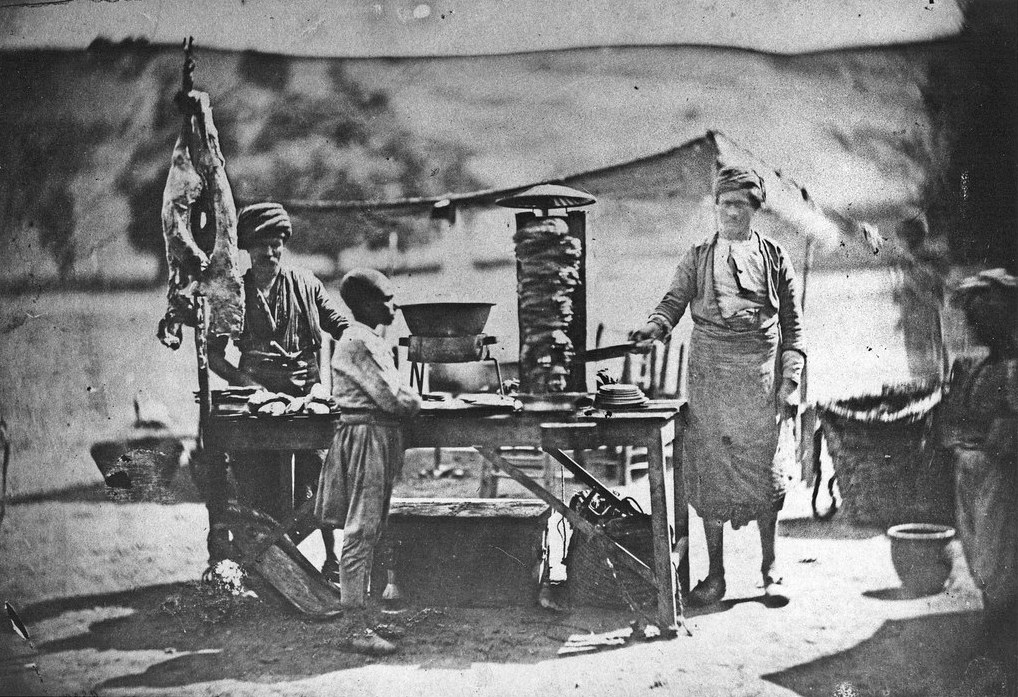
Figure 20. This is considered the first photograph of a döner kebab restaurant, taken by James Robertson in 1855. Pieces of lamb sit on a wooden table to the left of the frame, and at the other end of the table, a döner kebab is strung on a hook behind it, cooking over a charcoal fire. – Wikipedia
Appendix VII – Ancient City
Prusa or Prousa, sometimes called Prusa near Olympus or Prusa under Olympus, was an ancient city in Bithynia, situated at the northern foot of what was once known as Mysian Olympus, today’s Uludağ, [87] According to Pliny the Elder, King Prusias I established the city with guidance from the famous general Hannibal, who was residing at his court at the time. [88] The city took its name from its founder, Prusias. [89]
Dio Chrysostom, a notable resident of Prusa in the first and second centuries CE, described the city as neither particularly old nor large. [90] Yet, Strabo noted that Prusa was well-managed, prospered under Roman rule, and was celebrated for its thermal baths, called the “royal waters.” [91]
During the Roman era, Prusa faced considerable challenges during conflicts with the Ottoman Turks. Eventually, it fell and was renamed Bursa, becoming the first capital of the Ottoman Empire for a period. [92]
Today, the ancient site of Prusa is home to the modern city of Bursa in Turkey. [93]
Image 21 Figure 21. Panorama depicting the conquest of Bursa in 1326 by the Ottomans. Artist: Oksana Legka (Source)
Appendix VIII – Why are There No Works of Mimar Sinan in Bursa? [107]
The only structure attributed to Sinan in Bursa is the Galle Han (Grain Inn), also known as the Tahıl Hanı or Alizade Paşa Hanı, located at the intersection of Cumhuriyet and İnönü streets.[94] Built in the sixteenth century by Grand Vizier Semiz Alizade Paşa during the reign of Sultan Süleyman the Magnificent, it served as a grain exchange for wheat, barley, and other grains.[95] It is said he was an apprentice at that time.[96] Severely damaged in the 1855 earthquake, the inn suffered further damage when Cumhuriyet Street was cut through its middle in 1906, leaving it divided and primarily in ruins.[97] Today, only fragments of its walls and rooms survive, further disfigured by crude modern restorations.
According to a popular anecdote, Sultan Selim II once requested that Sinan build a mausoleum in Bursa for his ill-fated brother, Şehzade Mustafa. Sinan is said to have refused, explaining:
“This city already possesses a spirit inherited from our ancestors, a spirit that came from Asia through the Seljuks and into the Ottomans. I cannot add to it. If you wish, give this task to another servant.”[98]
While historically uncertain, this tale reflects the perception that Bursa’s sacred and architectural aura was already complete, leaving even the empire’s greatest architect reluctant to intervene.
In truth, Bursa’s architectural landscape had been firmly established long before Sinan’s career, dominated by early Ottoman foundations such as the Ulu Cami, the Green Mosque, and the monumental tombs of the dynasty. The absence of Sinan’s works thus speaks less to neglect and more to the city’s already-settled architectural character. What has altered Bursa more profoundly than any architect has been the encroachment of modern construction, apartment blocks and intrusive “restorations”, which have scarred the city in ways that even Timur’s armies did not inflict.[99]
Image 23 Figure 23. Galle Han – Görsel Sahibi: Bursa Valiliği (Source)
Appendix IX – Theories
There are shrines of companions (ṣaḥāba) of the Prophet Muḥammad in Istanbul, a city closely tied to Bursa both geographically and historically. In Islamic tradition, the conquest of Constantinople was foretold in a prophetic saying (ḥadīth), which inspired several waves of Arab military campaigns in the 7th and 8th centuries.[109] As these armies advanced toward the city, they would have passed through northwestern Anatolia, including the vicinity of Bursa.[101] The Prophet is reported to have said:
“You will conquer Constantinople. Blessed is the commander who conquers it, and blessed is the army that will do so.”[102]
Particularly in the town of Umurbey, Gemlik (Bursa Province), it is assumed that around twenty-one companions of the Prophet are buried in an area said to be the ŞehitSahabe Mezarlığı (Mytred Sahaba Cemetery). This belief often appears on social media and news outlets, but not much in regional memory.[103] While claims of companions’ burials in Gemlik might have some merit, they remain unconfirmed by historical or scholarly evidence. There are no contemporary Islamic sources that explicitly mention companions passing, settling or dying in or near Bursa (Prusa at that time).[104] Instead, what is clear is that Bursa and its surrounding landscape became dotted, over the centuries, with shrines and tombs of venerated scholars (such as Sufis, Muslim saints, etc.), including Emir Sultan and Geyikli Baba, testifying to the city’s enduring religious and spiritual heritage.[105]
However, this observation may provide a plausible linguistic explanation for the city’s name. The ancient Greek name was Prusa or Prousa, as noted above.[106] In some historical sources, the form appears as Poursa and later Boursa.[107] The shift from “P” to “B” is typical when words are rendered into Arabic, since Classical Arabic lacks the /p/ sound and substitutes it with /b/.[108] Thus, when Arab historians or travellers referred to the city, Prusa naturally became Bursa. It is also possible that Ottoman scribes, writing in Turkish with the Arabic alphabet, adopted this phonetic form.[109] A parallel can be found in the way “Portugal” appears as “Bortugal” in some Arabic texts.[110] In this sense, the modern name Bursa likely reflects Arabic phonetic influence layered onto the city’s original Greek name.
[01] UNESCO Silk Roads Programme. Bursa. (UNESCO, 2014). — Discusses Bursa as “Yeşil Bursa,” early Ottoman capital, and its Silk Road role. [02] Faroqhi, Suraiya. Subjects of the Sultan: Culture and Daily Life in the Ottoman Empire. (London: I.B. Tauris, 2005). — Notes Ottoman horticultural heritage and silk production in Bursa. [03] İnalcık, Halil. The Ottoman Empire: The Classical Age 1300–1600. (London: Weidenfeld & Nicolson, 1973). — Covers the history of Bursa from the Greeks to the Ottomans. [04] Goodwin, Godfrey. A History of Ottoman Architecture. (London: Thames & Hudson, 1971). — Details Green Tomb and Iznik-tile mausoleums. [05] Encyclopædia Britannica. Ottoman Empire – Osman, Orhan, Expansion, britannica.com, accessed August 2025. — Discusses Orhan’s conquest of Bursa and early Ottoman administration. [06] Finkel, Caroline. Osman’s Dream: The History of the Ottoman Empire. (London: John Murray, 2005). — Mentions Bursa as a hub on trade and knowledge networks. [07] Ministry of Culture and Tourism. Mudanya Armistice House Museum, kultur.gov.tr, accessed August 2025. — Covers Mudanya’s Ottoman architecture and historical significance. [08] UNESCO World Heritage Centre. Bursa and Cumalıkızık: the Birth of the Ottoman Empire, whc.unesco.org, accessed August 2025. — Describes Cumalıkızık’s preservation of early Ottoman rural life. [09] Bursa Provincial Directorate of Culture and Tourism. Karacabey, Orhaneli and Gölyazı, bursa.ktb.gov.tr, accessed August 2025. — Details villages’ agricultural, forest, and fishing heritage.
[10] Faroqhi, Suraiya. Ibid., pp. 48–52. — Discusses Bursa’s silk production, textiles, and cultural prestige.
[11] Öztürk, Nuran. Ottoman Carpets: Art and Trade. (Istanbul: Istanbul University Press, 2012), pp. 35–37. — Covers Bursa’s carpets and their role in palace and mosque decoration.
[12] Goodwin, Godfrey. Ibid., pp. 153–156. — Details the Green Mosque, its tiled mihrab, and architectural significance.
[13] Kuban, Doğan. Ottoman Architecture. (Singapore: Akademi Press, 2010), pp. 89–94. — Discusses Ulu Cami and Green Mosque, a synthesis of Byzantine and Islamic architecture.
[14] Necipoğlu, Gülru. The Age of Sinan: Architectural Culture in the Ottoman Empire. (London: Reaktion Books, 2005), pp. 21–25. — Examines domes, tilework, and courtyards as hallmarks of early Ottoman engineering and artistry.
[15] Encyclopædia Britannica. Green Mosque (Yeşil Camii), Bursa, britannica.com, accessed August 2025. — Covers külliye components, Sultan Mehmed I, and Bursa’s role as an early Ottoman capital.
[16] Gutas, Dimitri. Greek Thought, Arabic Culture: The Graeco-Arabic Translation Movement in Baghdad and Early Abbasid Society. (London: Routledge, 1998), pp. 72–85. — Discusses preservation and transmission of classical texts.
[17] Saliba, George. A History of Arabic Astronomy: Planetary Theories During the Golden Age of Islam. (New York: New York University Press, 1994), pp. 10–15. — Covers classical scholarship on medicine, astronomy, and philosophy.
[18] Faroqhi, Suraiya. Subjects of the Sultan: Culture and Daily Life in the Ottoman Empire. (London: I.B. Tauris, 2005), pp. 60–63. — Discusses Yıldırım Hospital and integration of education with medical practice in Bursa.
[18.a] T.C. Bursa Valiliği. bursa.gov.tr
[19] Kafadar, Cemal. Between Two Worlds: The Construction of the Ottoman State. (Berkeley: University of California Press, 1995), pp. 123–125. — Details Molla Fenârî’s life and intellectual contributions.
[20] Üftade Hazretleri. Bâğ-ı Aşkın Andelîbi, arsiv.nefesyayinevi.com, accessed August 2025. — Original poetry source reflecting spiritual teachings.
[21] Aziz Mahmud Hüdayi, Alıntılar, 1000kitap.com, accessed August 2025. — Spiritual poetry and teachings of Hüdayi in Bursa.
[22] Somuncu Baba, quoted in Erdem, Yusuf. Sufi Masters of Anatolia. (Istanbul: Kitabevi, 2010), pp. 47–50. — Discusses Somuncu Baba’s life and role in Ulu Cami.
[23] Diyanet İşleri Başkanlığı, TDV İslâm Ansiklopedisi, Süleyman Çelebi ve Mevlid, https://islamansiklopedisi.org.tr/suleyman-celebi, accessed August 2025. — Details Süleyman Çelebi’s Mevlid and spiritual contribution.
[24] Bursa İl Kültür ve Turizm Müdürlüğü. Mevlid-i Şerif ve Süleyman Çelebi Türbesi, https://bursa.ktb.gov.tr, accessed August 2025. — Confirms tomb and devotional practices.
[25] TDV İslâm Ansiklopedisi, İsmail Hakkı Bursevî, https://islamansiklopedisi.org.tr/ismail-hakki-bursevi, accessed August 2025. — Biography and works of Bursevî.
[26] Bursa İl Kültür ve Turizm Müdürlüğü. İsmail Hakkı Bursevî Türbesi, https://bursa.ktb.gov.tr, accessed August 2025. — Discusses burial site and Sufi legacy.
[27] Goodwin, Godfrey. Ibid., pp. 248–250. — Discusses Sinan’s restoration work in Bursa, including the Muradiye Complex, and philosophy on architectural harmony.
[28] Evliya Çelebi. Seyahatname, Volume II, ed. Robert Dankoff and Sooyong Kim. (Seattle: University of Washington Press, 2013), pp. 45–50. — Describes Bursa’s urban layout, architecture, and commercial life.
[29] Ibid., pp. 52–53. — Bursa as “the land of silk,” with diverse neighbourhoods.
[30] Matrakçı Nasuh. Beyan-ı Menazil-i Sefer-i Irakeyn, ed. Mustafa Kaçar. (Istanbul: Kitap Yayınevi, 2010), pp. 12–18. — Discusses Nasuh’s cartographic style, surviving miniatures, and potential depiction of Bursa.
[30a] Karamustafa, Ahmet T. God’s Unruly Friends: Dervish Groups in the Islamic Later Middle Period, 1200–1550. Salt Lake City: University of Utah Press, 1994.
[30b] Robert Dankoff, Maḥmūd al-Kāshgharī: Compendium of the Turkic Dialects (Dīwān Lughāt al-Turk), 3 vols. (Cambridge, MA: Harvard University Press, 1982–85).
[31] İnalcık, Halil. The Ottoman Empire: The Classical Age, 1300–1600. (London: Phoenix Press, 1994), pp. 256–257. — Early Ottoman medical institutions and Hacı Paşa’s contributions.
[32] Nafi, Basheer M. Ottoman Sufism and the Celvetiyye Order. (Leiden: Brill, 2003), pp. 101–105. — Aziz Mahmud Hüdayi’s activity and influence in Bursa.
[33] Fleischer, Cornell H. Bureaucrat and Intellectual in the Ottoman Empire. (Princeton: Princeton University Press, 1986), pp. 89–90. — Mehmed Efendi of Bursa and historiographical contributions.
[34] Kafadar, Cemal. Between Two Worlds: The Construction of the Ottoman State. (Berkeley: University of California Press, 1995), pp. 145–146. — Kadı Seyyid’s role in Bursa’s legal and educational institutions.
[35] Goodwin, Godfrey. Pp. 251–252. — Hacı Taşan Efendi’s contributions to early Ottoman construction in Bursa.
[36] Dhanani, Alnoor. Avicenna and the Canon of Medicine in the Ottoman Empire. (Leiden: Brill, 2010), pp. 112–115. — Discusses study of Ibn Sina’s works in Ottoman madrasas, including Bursa.
[37] Savage-Smith, Emilie. Rhazes and Early Ottoman Medicine. (London: Wellcome Institute, 1997), pp. 78–80. — Al-Razi’s treatises are preserved in Yıldırım Hospital and Bursa’s medical schools.
[38] Gutas, Dimitri. Ibn al-Nafis: His Works and Influence in the Ottoman World. (Leiden: Brill, 2001), pp. 45–46. — Inclusion of Ibn al-Nafis in Ottoman medical curricula.
[39] Kafadar, Cemal. Between Two Worlds: The Construction of the Ottoman State. (Berkeley: University of California Press, 1995), pp. 150–151. — References Süleyman ibn Abdullah and Ottoman medical figures in Bursa.
[40] Rashed, Roshdi. Science and Learning in the Ottoman Empire: Taqi al-Din and Observatories. (Istanbul: IRCICA, 2007), pp. 90–92. — Taqi al-Din’s contributions in Bursa madrasas and observatories.
[41] Sezgin, Fuat. Geschichte des arabischen Schrifttums, Vol. VI: Mathematische und naturwissenschaftliche Schriften. (Leiden: Brill, 1974), pp. 310–312. — Ali Qushji’s references in Bursa institutions.
[42] Ibn Battuta. The Travels of Ibn Battuta, trans. H.A.R. Gibb. (London: Routledge, 2000), pp. 228–230. — Detailed description of Bursa, its markets, baths, gardens, thermal springs, and Orhan Gazi’s rule.
[43] Faroqhi, Suraiya. Subjects of the Sultan: Culture and Daily Life in the Ottoman Empire. (London: I.B. Tauris, 2005), pp. 102–104. — Discusses Bursa as a hub for preservation and transmission of knowledge.
[44] International 7 Saints 7 Cities Short Film Festival. Festival Brochure 2023. (Bursa: 7 Cities Festival Committee, 2023), pp. 12–15. — Celebrates Bursa’s contribution to Islamic intellectual and artistic heritage.
[45] Hodgson, Marshall G.S. The Venture of Islam: Conscience and History in a World Civilization, Vol. 2. (Chicago: University of Chicago Press, 1974), pp. 128–130. — Overview of scientific and cultural development during the Islamic Golden Age.
[46] Gutas, Dimitri. Greek Thought, Arabic Culture: The Graeco-Arabic Translation Movement in Baghdad and Early Abbasid Society. (London: Routledge, 1998), pp. 45–47. — Translation and knowledge transfer in Baghdad’s House of Wisdom.
[47] Sabra, A.I. Optics, Astronomy and Mathematics in Medieval Islamic Scholarship. (Leiden: Brill, 2000), pp. 59–61. — Al-Khwarizmi’s algebra and Al-Haytham’s optics.
[48] Blair, Sheila. Islamic Calligraphy. (Edinburgh: Edinburgh University Press, 2006), pp. 25–27. — Development of arts in the Islamic world.
[49] Faroqhi, Suraiya. Ibid., pp. 105–107. — Bursa’s role as a conduit and conservator of Islamic Golden Age heritage.
[50] Kafadar, Cemal. Between Two Worlds: The Construction of the Ottoman State. (Berkeley: University of California Press, 1995), pp. 34–36. — Covers Orhan Gazi’s reign and the conquest of Bursa.
[50a] Bonner, Michael. Jihad in Islamic History: Doctrines and Practice. Princeton: Princeton University Press, 2006.
– Also see Ghazi (warrior) – en.wikipedia.org
[51] Imber, Colin. The Ottoman Empire, 1300–1650: The Structure of Power. (London: Palgrave Macmillan, 2002), pp. 22–25. — Discusses administrative, cultural, and educational developments under Orhan Gazi.
[52] Lowry, Heath W. Bursa in the Early Ottoman Period. (Istanbul: Eren Yayıncılık, 2005), pp. 15–17. — Details Bursa as a hub of trade, architecture, and knowledge.
[53] Öztuna, Yılmaz. Türk Tiyatrosu Tarihi. (Istanbul: Milliyet Yayınları, 1975), pp. 10–12. — Notes cultural innovations such as Karagöz and Hacivat.
[54] Kafadar, Cemal. Ibid., pp. 37–38. — Territorial expansion, population growth, and military organisation.
[55] Imber, Colin. Ibid., pp. 26–27. — Military structure and campaign organisation.
[56] Faroqhi, Suraiya. Subjects of the Sultan: Culture and Daily Life in the Ottoman Empire. (London: I.B. Tauris, 2005), pp. 58–60. — Christian communities under Orhan Gazi’s administration.
[56] Şen, Ozan. Karagöz ve Hacivat: Geleneksel Türk Gölge Oyunu. İstanbul: Türkiye İş Bankası Kültür Yayınları, 2011. — Discusses the origin of Karagöz and Hacivat during the reign of Orhan Gazi in Bursa, including its cultural and social significance.
[57] Bursa Büyükşehir Belediyesi Kültür ve Turizm Müdürlüğü. Karagöz ve Hacivat Müzesi Rehberi. Bursa: BBKTM Yayınları, 2020. — Provides detailed information on the museum, its collections, and the preservation of the shadow puppetry tradition in Bursa.
[58]Freely, John. Jem Sultan: The Adventures of a Captive Turkish Prince in Renaissance Europe [59] İnalcık, Halil. The Ottoman Empire: The Classical Age, 1300–1600. London: Phoenix Press, 2000, pp. 56–57. — Discusses Cem Sultan’s claim to Anatolia, brief rule in Bursa, and political struggles with Bayezid II.
Kafadar, Cemal. Between Two Worlds: The Construction of the Ottoman State. Berkeley: University of California Press, 1995, pp. 112–114. — Examines coinage and official decrees issued by Cem Sultan during his Bursa interlude.
[61] Goodwin, Godfrey. The Ottoman Empire: From Suleiman to Cem Sultan. London: Thames & Hudson, 1998, pp. 78–79. — Provides details of Cem Sultan’s exile and death in Naples.
[62] Necipoğlu, Gülru. The Age of Sinan: Architectural Culture in the Ottoman Empire. London: Reaktion Books, 2005, pp. 42–43. — Mentions Cem Sultan’s burial at Muradiye Tombs and Bursa’s dynastic significance.
[63] Yazıcı, İsmail. Cem Sultan ve Edebiyatı. Ankara: Türk Tarih Kurumu Yayınları, 2012, pp. 23–28. — Discusses Cem Sultan’s literary contributions, Persian influences, and examples of his poetry.
[64] Ersoylu, İ. Halil (1989). Cem Sultan’ın Türkçe Divan’ı [65] Kuzubaş, Muhammet (2006), Cem Sultan’ın Şiirlerinde Hüzün [66] Freely, John. Ibid.herodotakademi.com, accessed August 2025. [67] Kuban, Doğan. Ottoman Architecture. (Reaktion Books, 2010). — Külliye as integrated civic-religious complexes.
[68] Kuban, Doğan. Ottoman Architecture. Istanbul: T.C. Ministry of Culture, 2010, pp. 112–115.
[69] Harper, Douglas. Online Etymology Dictionary, s.v. “college,” etymonline.com, accessed 19 Aug 2025.
[70] Kafadar, Cemal. Between Two Worlds: The Construction of the Ottoman State. Berkeley: University of California Press, 1995, pp. 78–80.
[71] Makdisi, George. The Rise of Colleges: Institutions of Learning in the Islamic World and Europe. Edinburgh: Edinburgh University Press, 1981, pp. 45–50.
[72] Bilgin, Hamit. Robert College: A History. Istanbul: Robert College Press, 2006, pp. 23–25.
[73] Findley, Carter Vaughn. Turkey, Islam, Nationalism, and Modernity: A History, 1789–2007. New Haven: Yale University Press, 2010, pp. 142–145.
[74] Sencan Gürtunca, Evrim. “The Külliye and its Educational Role in Ottoman Society.” Journal of Ottoman Studies 48 (2015): 112–118, ataturkilkeleri.deu.edu.tr, accessed August 2025. [75] Kazhdan, Alexander. The Oxford Dictionary of Byzantium. Oxford: Oxford University Press, 1991, p. 179.
[76] Ibid.
[77] Ostrogorsky, George. History of the Byzantine State. New Brunswick: Rutgers University Press, 1969, p. 53.
[78] Halil İnalcık, The Ottoman Empire: The Classical Age 1300–1600 (London: Weidenfeld & Nicolson, 1973), 32–35.
– Also see Ottoman claim to Roman succession – en.wikipedia.org [79] Dimitri Kastritsis, The Sons of Bayezid: Empire Building and Representation in the Ottoman Civil War of 1402–1413 (Leiden: Brill, 2007), 28–30. [80] Franz Babinger, Mehmed the Conqueror and His Time, trans. Ralph Manheim (Princeton: Princeton University Press, 1978), 101–106. [81] Cemal Kafadar, Between Two Worlds: The Construction of the Ottoman State (Berkeley: University of California Press, 1995), 112–115.
[82] Stein, Peter. Roman Law in European History. Cambridge: Cambridge University Press, 1999, pp. 20–23.
[83] Ibid.; Ostrogorsky, History of the Byzantine State, p. 53.
[84] Wolf, Hieronymus. Corpus Historiae Byzantinae. Augsburg, 1555.
[85] Kaldellis, Anthony. Romanland: Ethnicity and Empire in Byzantium. Cambridge, MA: Harvard University Press, 2019, p. 5.
[86] Ibid.
[87] Gibbon, Edward. The History of the Decline and Fall of the Roman Empire. Vol. IV. London, 1776–1789.
[88] Davidson, A. (2014). The Oxford Companion to Food. Oxford University Press, p. 258.
[89] Ertuğ, Z. (2006). “İskender Kebabı ve Bursa’da Dönerin Doğuşu.” Türk Mutfak Kültürü Araştırmaları, Vol. 12, pp. 45–49.
[89a] Sami Zubaida and Richard Tapper, A Taste of Thyme: Culinary Cultures of the Middle East (London: Tauris Parke, 2000), pp. 118–120.
[90] Özdemir, Y. (2010). Bursa Mutfağı ve Yemek Kültürü. Bursa Büyükşehir Belediyesi Yayınları, pp. 112–115.
[91] Faroqhi, S. (2006). Artisans of Empire: Crafts and Craftspeople Under the Ottomans. I.B. Tauris, p. 212.
[92] Albala, K. (2011). Food Cultures of the World Encyclopedia. Greenwood Press, Vol. 2, pp. 311–312.
[93] Şahin, S. (2019). “The Global Journey of the Döner Kebab: From Bursa to Berlin.” Journal of Culinary History, 8(2), pp. 55–67.
[94] Pliny the Elder. Natural History, Book V. Loeb Classical Library. loebclassics.comaccessed August 2025.
– also see Prusa en.wikipedia.orgaccessed August 2025.
[95] Ibid.
[96] Dio Chrysostom. Discourses 45. LacusCurtius. penelope.uchicago.edu, accessed August 2025. [97] Strabo. Geography, Book III, Chapter 2. LacusCurtius. penelope.uchicago.edu , accessed August 2025. [98] Siege of Bursa. Vocham. vocham.com, accessed August 2025. [99] Prusa: a Pleiades place resource. Pleiades. pleiades.stoa.org, accessed August 2025. [100] Bursa`da Mimar Sinan Eseri Neden Yok? kitapevi.com.tr, accessed 2025.
[101] Ömer Lütfi Barkan, Süleymaniye Cami ve İmareti Tesisleri (Ankara: Türk Tarih Kurumu, 1962), p. 47. [102] Aptullah Kuran, The Mosque in Early Ottoman Architecture (Chicago: University of Chicago Press, 1968), p. 133. [103] Galle Han – Bursa. kulturportali.gov.tr, accessed 2025.
[104] Necdet Sevinç, 1855 Bursa Depremi ve Şehir Üzerindeki Etkileri (Bursa: Uludağ Yay ınları, 1995), pp. 72–74. [105] Doğan Kuban, Sinan’s Art and Selimiye (Istanbul: Hürriyet Vakfı Yayınları, 1987), p. 59.
[106] Musnad Ahmad ibn Ḥanbal, vol. 4, pp. 335.
[107] Walter E. Kaegi, Byzantium and the Early Islamic Conquests (Cambridge: Cambridge University Press, 1992), pp. 215–230.
[108] Musnad Ahmad ibn Ḥanbal, vol. 4, pp. 335.
[109] “Gemlik’te Sahabe Kabirleri,” TDV İslâm Ansiklopedisi, Google Search accessed 2025.
[110] H. Kennedy, The Great Arab Conquests: How the Spread of Islam Changed the World We Live In (Philadelphia: Da Capo Press, 2007), pp. 303–305.
[111] İ. Hakkı Uzunçarşılı, Osmanlı Tarihi, C. I (Ankara: Türk Tarih Kurumu, 1982), pp. 103–108; TDV İslâm Ansiklopedisi, “Emir Sultan” and “Geyikli Baba,” accessed 2025.
[112] Strabo, Geographica, Book XII, 8.11, ed. and trans. H.L. Jones (Cambridge: Harvard University Press, 1924). [113] Louis Robert, Études Anatoliennes: Recherches sur les Inscriptions Grecques de l’Asie Mineure (Paris: E. de Boccard, 1937), p. 115. [114] Joshua Blau, A Grammar of Christian Arabic (Louvain: Peeters, 1966), pp. 14–15. [115] Ibn Khurradādhbih, Kitāb al-Masālik wa’l-Mamālik, ed. M.J. de Goeje (Leiden: Brill, 1889), p. 120. [116] Federico Corriente, A Dictionary of Andalusi Arabic (Leiden: Brill, 1997), p. 41.
[117] Zeynep Ahunbay, “Osmanlı Anıtlarının Korunması ve Restorasyon Sorunları,” Sanat Tarihi Dergisi 5 (1996): 115–130.
This website uses cookies to improve your experience. We'll assume you're ok with this, but you can opt-out if you wish. Cookie settingsACCEPT
Privacy & Cookies Policy
Privacy Overview
This website uses cookies to improve your experience while you navigate through the website. Out of these cookies, the cookies that are categorized as necessary are stored on your browser as they are as essential for the working of basic functionalities of the website. We also use third-party cookies that help us analyze and understand how you use this website. These cookies will be stored in your browser only with your consent. You also have the option to opt-out of these cookies. But opting out of some of these cookies may have an effect on your browsing experience.
Necessary cookies are absolutely essential for the website to function properly. This category only includes cookies that ensures basic functionalities and security features of the website. These cookies do not store any personal information.