
Global Launch of 1001 Women: Early Muslim Women of Science, Medicine, Art and Management
by News Desk




Study suggests Copernicus was influenced by an ancient Muslim astronomer in developing his cosmological system
by Leon Barkho


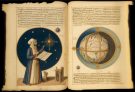
The article highlights how several lunar formations are named after prominent astronomers from the Muslim civilisation, acknowledging their significant contributions to the field of astronomy. First initiated in the 17th century by Jesuit scholar Riccioli and later formalized by the International Astronomical Union in 1935, these names honor figures such as Ibn al-Haytham, Al-Farghani, Al-Battani, Al-Zarqali, and others. Their pioneering work in optics, celestial measurements, and star catalogues had a lasting impact on both Islamic and European scientific traditions, reflecting the deep historical connection between scholars from the Muslim civilisation and the development of astronomy.
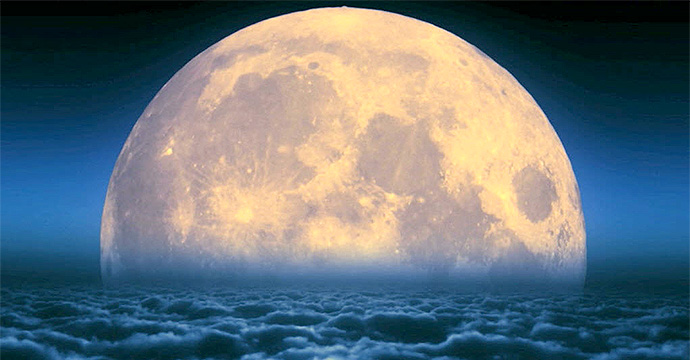
Figure 1. Image ©1001 Inventions (Source)
When viewed with the naked eye, the surface of the Moon appears unevenly bright, with dark and light patches. These features are called “lunar formations.”
In 1651, Joannes Baptista Riccioli, a Jesuit professor of astronomy and philosophy in Bologna, Italy, compiled a comprehensive work on astronomy, called Almagestum Novum, with a complete map of the Moon. He named the lunar formations after distinguished astronomers of the Middle Ages. Ten were given the names of astronomers and mathematicians from the Muslim civilisation.
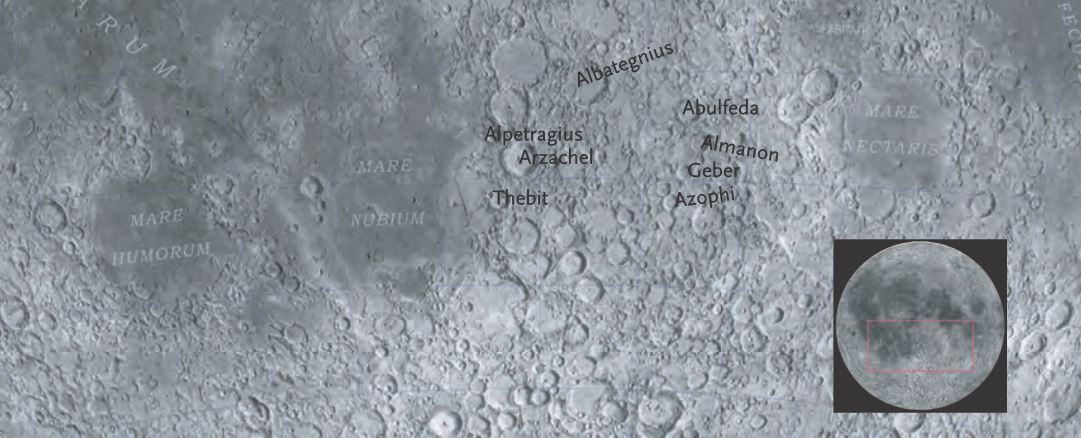 Figure 2. A lunar map shows the formations named after eminent scholars from Muslim civilisation. (Source: and 1001 Inventions: The Enduring Legacy of Muslim Civilization, 3rd edition, page 293)
These names were finally agreed upon at a conference of the International Astronomical Union in 1935. Of the 672 lunar formations, 13 were given the names of major Muslim astronomers, and since then more have been added. These names include:
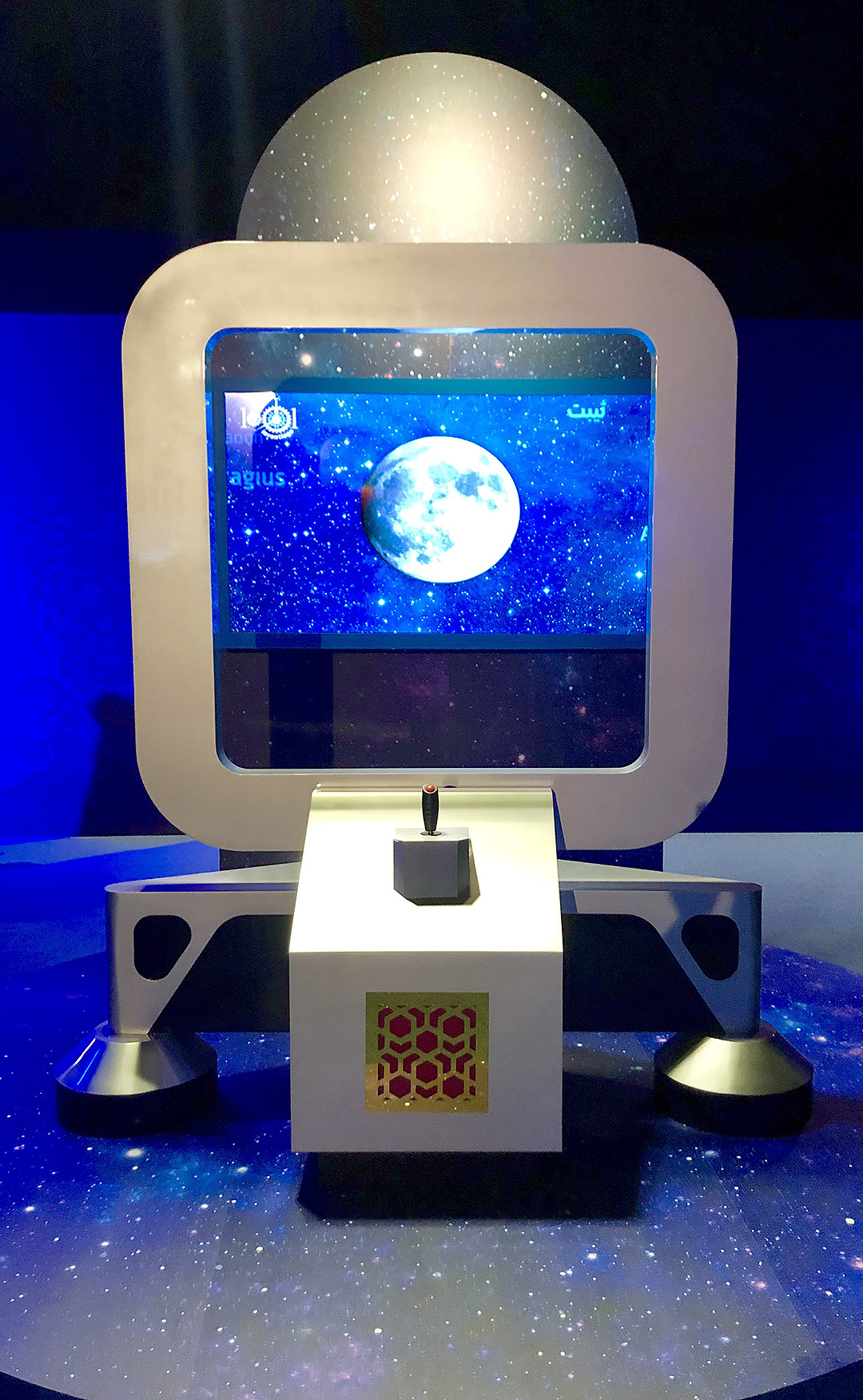 Figure 3. 1001 Inventions’ Mysteries of the Moon With Ibn Al-Haytham Exhibition in Makkah (Source) Figure 3. 1001 Inventions’ Mysteries of the Moon With Ibn Al-Haytham Exhibition in Makkah (Source) |
■ Messala is a plain in the 13th section of the Moon named after Masha’Allah, who was active in 809. He was a Jew from Egypt who embraced Islam during the time of the Abbasid caliph Al-Mansur. His work was translated into Latin in the Middle Ages and was used profusely by Chaucer.[1] Two of his books on astronomy were translated into Latin in the 16th century: De Scientia Motus Orbis and De compositione et utilitate astrolabii.
■ Almanon is a crater in the ninth section named after Caliph Al-Ma’mun, the son of Harun al-Rashid and sponsor of Bayt al-Hikmah, the House of Wisdom.
■ Alfraganus is a crater in the second section named after Al-Farghani, who died around 861. He was one of Al-Ma’mun’s team of researchers in astronomy. He wrote the Book of the Summary of Astronomy, and this was the main influence for the Italian poet Dante.
■ Albategnius is a plain in the first section named after Al-Battani, who was born in 858. He determined many astronomical measurements with great accuracy.
■ Thabit is a prominent circular plain in the eighth section named after Thabit ibn Qurra, who died in Baghdad in 901. He translated into Arabic a large number of Greek and Syrian works on science. He also made major contributions of his own to pure mathematics.
■ Azophi is a mountainous ring in the ninth section named after the tenth-century ’Abd al-Rahman al-Sufi. Al-Sufi’s illustrated book, The Book of Fixed Stars, is on stellar astronomy.
 Figure 4. www.ibnalhaytham.com Figure 4. www.ibnalhaytham.com |
■ Alhazen is a ring-shaped plain in the 12th section named after Abu Ali al-Hasan ibn al-Haytham; he is usually known as Ibn al-Haytham.
■ Arzachel is a plain in the eighth section named after Al-Zarqali, who prepared the Toledan Tables. His work may have influenced that of Copernicus.
■ Geber is a circular, flat plain in the ninth section named after Jabir ibn Aflah, who died in 1145. He was a Spanish Muslim who was the first to design a portable celestial sphere to measure celestial coordinates, today called a torquetum.
■ Nasireddin is a crater 30 miles (48 kilometres) in diameter named after Nasir al-Din al-Tusi, who was born in 1201. Though a Muslim, he was a minister and advisor to Hulagu, the Mongol ruler of Persia from 1256 to 1265, who destroyed Baghdad and much of Syria and slew millions of Muslims. [2] He was put in charge of the observatory installed at Maragha by Hulagu, and of preparing the Ilkhanid Tables and The Book of Fixed Stars, which remained in use for several centuries in many parts of the world.
■ Alpetragius is a crater in the eighth section named after Nur al-Din ibn Ishaq al-Bitruji, who was born in Morocco, lived in Ishbiliah (Seville), and died around 1204. He worked hard, unsuccessfully, at modifying Ptolemy’s system of planetary motions. Al-Bitruji’s book On Astronomy was popular in 13th-century Europe in its Latin translation.
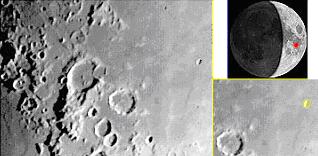 Figure 5. Crater Ibn Battuta on the Moon [6.9oS, 50.4oE]. (Source) Figure 5. Crater Ibn Battuta on the Moon [6.9oS, 50.4oE]. (Source) |
■ Abulfeda is a circular plain in the ninth section named after Abu al-Fida’, who was born in 1273 in Syria. He was geographer, historian, astronomer, and military commander.
■ Ulugh Beigh is a prominent elliptical ring in the 18th section named after Ulugh Beg (1394-1449), founder of the observatory in Samarkand. His most commendable and enduring work was a new catalogue of stars.
[1] W. W. Skeat, A Treatise on The Astrolabe by Geofrey Chaucer, edited from the earliest ms. (London: Early English Text Society, 1872), see preface for summary of matter.
[2] G. d’Ohsson, Histoire des Mongols, op. cit, 225-26.
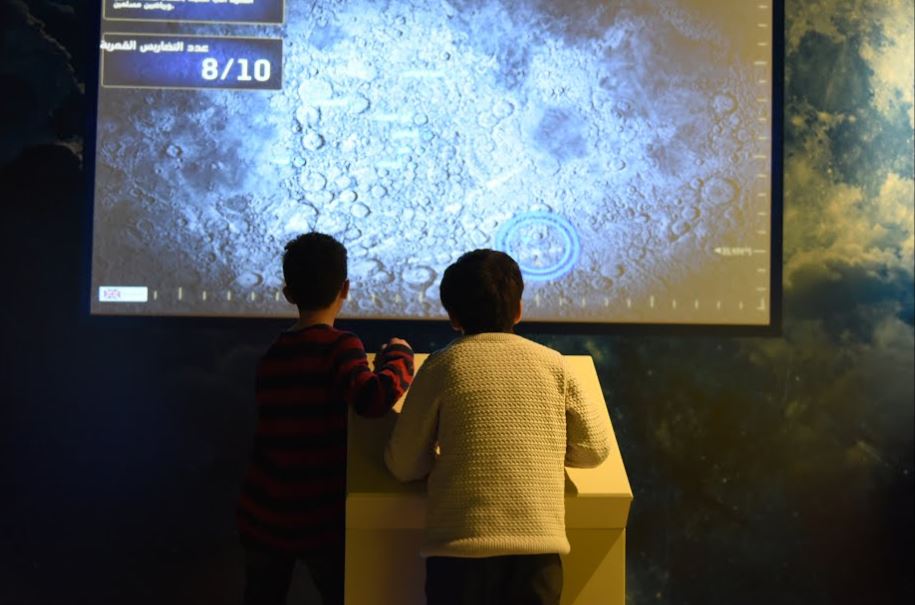
Google Arts & Culture: Children discovering lunar formations in the moon game interactive at a 1001 Inventions exhibition

Discover the golden
age of Muslim civilisation.

© Copyright FSTC Ltd 2002-2020. All Rights Reserved.