




Lunar Formations and Astronomers from Muslim Civilisation
by Salim Al-Hassani - 1001 Book Chief Editor
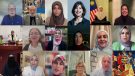
On 15 July 2026, the global launch of 1001 Women: Early Muslim Women of Science, Medicine, Art, and Management by Professor Salim Al-Hassani, President of FSTC, took place as a Zoom webinar between 6:00–8:00 pm UK time. The event featured distinguished speakers from around the world sharing brief reflections on the book and its significance, including video messages from Rt Hon Lucy Powell, Labour MP for Manchester Central and Secretary of State for Education; Dr Wan Azizah, First Lady of Malaysia; HE Ambassador of Libya to Oman, Hajar El-Nami; and Dr Naushaba Hasan Murad, Chair of Women Institute of Learning and Leadership, Pakistan. Other speeches were given live from HRH Princess Adelah bint Abdullah of Saudi Arabia; Prof Salwa Al-Noori at the University of Washington; Prof Wijdan Enad, College of Education for Women, University of Baghdad; Dr Sahira Dar, President of British Islamic Medical Association (BIMA); Prof Rana Dajani, Hashemite University, Jordan; Zara Mohammed, Former Secretary General of Muslim Council of Britain (MCB); Dr Dilara Tekden Kirgiz, Women's health specialist, Türkiye; A. M. Dassu, Internationally acclaimed author of children's books, UK and Dr Anne-Maria Brennan, University of Kent. Concluding remarks were given by Prof Sharif Kaf Al-Ghazal, Vice President of FSTC.
To register your interest in the e-book of 1001 Women and interactive resources, click here: www.1001women.org.uk
00:00 – Introduction from Peter Fell, Chair of FSTC & Chairman of Webinar
06:42 – Keynote presentation: Prof Salim Al-Hassani, Emeritus Professor, University of Manchester
22:07 – Summary of the Book: Fatima Sharif, FSTC Research Assistant
31:36 – Video message from Rt Hon Lucy Powell
33:23 – Video message from First Lady Malaysia, Dr Wan Azizah
44:07 – HRH Princess Adelah bint Abdullah, Saudi Arabia
48:52 – Video message from HE Ambassador Hajar El-Nami
53:59 – Prof Salwa Al-Noori, University of Washington
1:01:48 – Prof Wijdan Enad, College of Education for Women, University of Baghdad
1:05:43 – Dr Sahira Dar, President of British Islamic Medical Association (BIMA)
1:10:50 – Prof Rana Dajani, Hashemite University, Jordan
1:16:00 – Zara Mohammed, Former Sec. Gen. Muslim Council of Britain (MCB)
1:20:19 – Video message from Dr Naushaba Hasan Murad, Chair of Women Institute of Learning and Leadership, Pakistan
1:24:04 – Dr Dilara Tekden Kirgiz, Women’s health specialist, Turkiye
1:29:41 – A. M. Dassu, internationally acclaimed author of children’s books, UK
1:36:33 – Dr Anne-Maria Brennan, University of Kent
1:42:18 – Concluding remarks: Prof Sharif Kaf Al-Ghazal, Vice President of FSTC

Below are the speeches of Peter Fell, Chair of FSTC and Chairman of the Webinar; Prof. Salim Al-Hassani, author of the book and President of FSTC; and Fatima Sharif, FSTC Research Assistant.
Welcome and good evening from the UK.
My name is Peter Fell, and I am the chair of the Foundation for Science, Technology and Civilisation. I will be your host and chair this evening.
I will, if I may, say a few words about our Foundation and the arrangements for the webinar tonight.
The Foundation for Science, Technology and Civilisation is a UK-based not-for-profit, non-political, and non-religious organisation. Its purpose is to research and popularise the history of pre-Renaissance civilisations, especially Muslim civilisation, that have had an impact on the scientific, technological, and cultural heritage of our modern world.
For over 25 years, we have initiated and delivered a number of initiatives which have had both local and global reach. These include initiatives such as 1001 Inventions, which shed light on the enduring legacies of Muslim civilisation and featured a global touring exhibition; 1001 Cures, which explored the contributions in medicine & healthcare from Muslim civilisation; and https://muslimheritage.com/, a popular repository where academics share their research to wider audiences. We have also produced guides and resources for STEM educators to incorporate into their lessons, and organised international conferences featuring renowned speakers of high academic standing.
Tonight we are soft-launching our latest book “1001 Women: Early Muslim Women of Science, Medicine, Art and Management”. 1001 Women is another groundbreaking work by my dear friend and colleague, Prof. Al-Hassani. Prof. Al-Hassani is an Emeritus Professor of Mechanical Engineering at the University of Manchester, where he was also awarded an Honorary Professorial Fellowship in the Faculty of Humanities. He has become a highly respected historian of science and engineering, was elected a Fellow of the British Science Association, and has received numerous awards for his work on Muslim Heritage in Science. And if that wasn’t enough, he is also listed among the top 500 most influential Muslims worldwide.
This topic is highly relevant to our modern world. Women have been largely neglected or relegated to secondary roles in Western and non-Western narratives of science, medicine, and technology. 1001 Women seeks to redress this gap. It focuses on the 7-15th centuries of Muslim civilisation. Our new project seeks to ensure that women’s contributions are not only recognised but understood in relation to modern academic and technological disciplines. At its core, the project is dedicated to shining a light on the lost names of Muslim women in history while showcasing role models of excellence for women of all backgrounds to aspire to.
While this work is, of course, a celebration of women’s unsung achievements, our aim as a Foundation is not to propagate any suite of ideas. This book is not intended to promote any religious, sectarian, or political ideology. It does not advocate for any model of religious orthodoxy. It does not seek to promote any group of people over another. In this work, as in all his others, Prof. Al-Hassani is seeking to rectify major gaps in our knowledge– in this case concerning the early pioneering women of Muslim civilisation.
This project is also more than just a digital and hard copy book. It will be accompanied by a virtual map, timeline, and network feature, available on 1001women.org.uk, allowing readers to explore the remarkable, trailblazing figures featured in this work geographically, chronologically, and in relation to their family members mentioned in the book.
We are sure that this initiative will serve as a valuable resource for researchers and anyone with an interest in the subject. We hope that by bringing these names to the forefront of history, we can inspire future generations of women to pursue academic study and careers in STEM, literature, the arts, and management. Our ambition is to establish a network of young women who can drive forward some of the themes in the book to advance knowledge and enhance cohesion between different cultures.
I will be asking Professor Al-Hassani to introduce and tell us about his journey with the book, followed by Fatima Sharif, our research assistant. I will then share a video message from HE Dr Wan Azizah, the First Lady of Malaysia, who, sadly, will not be able to join in person today. This will be followed by some words from HRH Princess Adelah of Saudi Arabia, then by HE Ambassador Hajar El-Nami, the Libyan Ambassador to Oman, who has shared a video message too. I will then ask our respected panelists to speak for no more than 3 minutes each, giving their reflections and comments.
The hard copy of the book will soon be available for pre-order on Amazon, and we will email all attendees the link when that becomes available in the coming weeks. An electronic version of the book in PDF format will be available soon, along with interactive resources, and we ask you to register your interest on our website 1001women.org.uk to be notified when the e-book and interactive resources are released. We will share the link to our website in the chat so you can register your interest there.
I hope you enjoy the evening. I have a promise to those who love football: we will finish well ahead of the England Argentina World Cup semi-final tonight, which I for one am really looking forward to.
Professor, the floor is yours…….
Thank you, Chairman, Right Honourable Lucy Powell, Your Royal Highness Princess Adila al-Saud, Your Excellency Dato Seri Dr Wan Azizah Dr Wan Ismail, Your Excellency Ambassador Hajar el-Nami, and honourable guests.
Assalamu alaykum. Peace be with you. Good evening and thank you all for being here.
It is a great honour to speak to you today at the launch of 1001 Women.
This event is not merely the launch of a book. For me, it is the completion of a journey that began many years ago with a question: a question that, at the time, I could not have imagined would lead to such an extensive and rewarding search.
In 2004 Professor William Johnson, Fellow of the Royal Society, was telling me about his discovery of the work of Hypatia of Alexandria, the 4th-century philosopher and mathematician. He then asked me a question that would stay with me for many years: Were there women in Muslim civilisation who made significant contributions in science and other fields?
That question was repeated again by other distinguished academics after the publication of 1001 Inventions.
It seemed like a simple and reasonable question. But the more I reflected on it, the more I realised that it opened a much larger door: a door into a largely underexplored world of scholarship and historical discovery.
I did not initially set out to write this book. I did not begin with a fixed title, a clear structure, or even a full sense of what I would find. What began as a question became a search. And what began as a search became, in time, a momentous journey of discovery.
That journey led me through Arabic chronicles, biographical dictionaries, scattered reports, and a wide range of primary and secondary sources. Slowly, I came to see that there were hundreds of extraordinary women in Muslim civilisation whose names and achievements had been left at the margins of popular historical narratives.
They were medics, scientists, scholars, jurists, preachers, educators, poets, scribes, artists, leaders, rulers, and philanthropists. In other words, women were not the exceptions to the story of civilisation; they were woven into it.
And yet, despite their significance, they are still too often absent from the books many people read, the lectures many people hear, and the assumptions many people inherit.
This absence is not a minor oversight. It shapes the way history is understood. It shapes how Muslim women are imagined and perceived historically and in the contemporary world. And it shapes what young people today believe is possible.
For generations, Muslim women from Muslim civilisations have often been portrayed through a narrow and flattened lens, confined to the domestic sphere, reduced to stereotypes, or viewed only through the prism of controversy and prejudice. But when one returns to the sources, a very different picture emerges.
Early Muslim women were active participants in the transmission of knowledge, the advancement of learning, and the development of their communities. They were not spectators in history – they were agents in it.
This book, therefore, is not simply a celebration. It is an attempt to address a significant gap in the research material available to students, academics, and general readers. It is also an attempt to restore balance to the historical narrative by recovering the contributions of women who have too often been rendered invisible.
I want to stress, however, that this book was never intended to be a slogan or manifesto in book form. It was not written to fit a modern ideological template, nor to serve solely as a rhetorical response to contemporary debates. Its primary aim is historical: to recover, document, and present what the sources allow us to know about these women, and to do so with as much care, honesty, and scholarly discipline as possible.
That is why methodology matters so much to me in this work.
I have relied extensively on Arabic chronicles, biographical dictionaries, and documentary evidence. Where possible, I have privileged primary sources. Where the evidence is scarce, I have mentioned this. Where a report appears only once and cannot be corroborated, I have treated it with caution.
In some cases, this means resisting the temptation to repeat attractive but weakly supported stories. That discipline is important because historical recovery must be guided not only by enthusiasm but by credibility.
In writing this book, I was also conscious of the challenge of classification. Early Muslim civilisation did not divide knowledge in the same way modern universities and societies do. The categories we use today – science, arts, medicine, management – are useful, but they also impose a modern framework.
So, I made deliberate choices to make the material accessible while remaining faithful to the historical record and to an understanding of different bodies of knowledge in early Muslim civilisation. I also introduced a category for endurance and patience to reflect the ability to manage pain and hardship in the face of persecution.
I also wanted the book to reflect the diversity of the women it discusses. These women came from different regions, dynasties, sects, and social backgrounds. Some were known for religious learning. Others for medical practice. Others for poetry, calligraphy, music, statecraft, administration, or endurance in the face of adversity. Their stories do not collapse into one simple model of excellence. That complexity, to me, is part of their greatness.
One of the most striking lessons I learned while writing this book is that women in early Muslim civilisation were often not merely participants in knowledge; they were custodians of it. They taught, transmitted, preserved, wrote, composed, treated, and advised. In some cases, they stood at the heart of intellectual and cultural life. In other cases, their influence was quieter, but no less real.
That quiet influence matters too.
Indeed, one of the strongest themes that emerged in my research was that, while they stood at the forefront, women were often also the invisible force behind the momentum of social change. They helped carry civilisation forward, but not always from the public stage.
And as I read more about them, I found myself repeatedly asking: Who were these women beyond the vignettes we have of them, and what did they strive for? What drove them to persevere through hardship, pain, and in some cases persecution? What enabled them to leave a mark on their societies, often despite great obstacles?
Those questions gave the project its emotional depth.
Because when we recover a woman’s name from obscurity, we recover more than just a name. We recover the mark they left in this world.
To the women who have joined us tonight, I would say this: your story did not begin in the modern age. You stand within a long and distinguished intellectual tradition. The women in this book remind us that Muslim women have long contributed to the public good, to learning, and to the shaping of society.
Their lives challenge the idea that faith and excellence are in tension. In their lives, faith was often the very source of excellence.
That is one of the reasons why I felt this book had to be written.
Not because the past needs idealisation, and not because every woman’s story needs to be fully known, but because the fragments we do possess are powerful enough to correct false assumptions and inspire deeper study.
Having said this, I see this book as only the beginning. You will not find 1001 names in the work, although there are certainly 1001 and even more names that could have gone in.
On the contrary, this work is an invitation to further research. There are still gaps to be filled, still questions to be answered and still regions and disciplines to be explored. But a beginning is necessary if fuller histories of these women are to emerge.
That is why 1001 Women matters……
I am deeply grateful to all who have supported this work, questioned it, encouraged it, and helped bring it to life. They are acknowledged in the book, but three very special people whose contributions were significant.
They are:
Research Assistant, Fatima Sharif, whom I gave the nickname of Pearls Diver because of her skill in finding and deciphering difficult primary sources, and in editing the text.
The second is Adil Salahi, the London based Quran and Hadith scholar, who regularly provided me with advice on intricate Islamic issues.
And the third is Professor Wijdan Fareeq Enad at the University of Baghdad, who was always available to source out rare manuscripts and primary sources from Archival libraries.
I also thank the audience tonight for sharing in this moment. Your presence is itself a sign that these stories do matter, and that there is still a genuine appetite for hearing the voices of those whose stories history did not privilege.
May this book open doors to further study and appreciation of the remarkable women whose lives illuminate the history of early Muslim civilisation.
Thank you.
Good evening, everyone, and assalamu alaykum.
Thank you, Peter, for your kind words. I’d also like to thank Prof Al-Hassani for his far too generous praise.
Now, let me begin with a question that was once put to a historian of the twentieth century, Bernard Lewis. The Moroccan sociologist Fatima Mernissi raised with him the subject of Arab women who had ruled as heads of state. And his reply was: “Arab women heads of state? Are you not mistaken about the area?”
Now, that reply – that easy, confident disbelief – is exactly the misconception this book was written to correct. Because the answer to his question is, of course, no. She was not mistaken. There were women who ruled. And there were women who healed, who taught, who calculated, who wrote, and who built. They were there all along. We had simply stopped telling their stories.
Now, this book is called 1001 Women: Early Muslim Women of Science, Medicine, Arts and Management. And over the next few minutes, I’d like to tell you what it is, why it matters, and introduce you to a few of the extraordinary women you’ll meet inside it.
This work gathers the lives of women who shaped early Muslim civilisation – as scholars, physicians, poets, calligraphers, patrons, and rulers – and it restores them to their rightful place as historical figures in their own right. Its central argument is a reconceptualisation: rather than the veiled, voiceless figures of orientalist fantasy, or the storytellers and singers of an older literary tradition, the women in these pages take centre stage. They are active participants in the transmission of knowledge and in the shaping of their societies.
The book takes its name from the One Thousand and One Nights, that celebrated collection of the Islamic Golden Age. But where the Arabian Nights confined its women to a narrow role, this book challenges the very assumptions behind that role. And it does so within a long tradition of Arabic scholarship on women, one stretching back to the ninth century, when Ibn Abi Tahir Tayfur composed the work Balaghat al-Nisa’, The Eloquence of Women, the earliest Arabic work devoted entirely to women’s literature. As the author, Professor Al-Hassani, points out, that is itself a telling reminder: some of the principal historians and biographers of these women were indeed men.
Now, the book is explicit about its purpose. Its central aim is to remedy a real gap: one that, Professor Al-Hassani argues, has left our very picture of world history unbalanced. And it is careful about what it is not. It is not written to advance any ideological model of empowerment. It simply makes women the subject of serious historical focus, recognised for their participation across a remarkable range of fields.
For too long, he writes, the Muslim woman has been treated as “a perplexing, elusive enigma”, the subject of literature written to entertain orientalist fantasies, rather than to document real achievement. This book answers that not with argument, but with evidence: with names, dates, sources, and lives. And it distinguishes itself from other fine recent works by spanning science, medicine, the arts, and management together, and by giving each woman a full contextual setting, rather than a bare biographical snapshot.
It also takes its evidence seriously. Professor Al-Hassani works from the original Arabic chronicles and biographical dictionaries, and where a claim rests on a single source, he flags it openly. His stated commitment, and it’s one that I admire, is, in his words, “unearthing factual narratives and upholding credibility, not celebrating fictitious heroines.” These women do not need to be embellished. The truth is remarkable enough.
The book gathers its women into four main domains: Science, Medicine, Literature and the Arts, and Management. Let me take you into each: just long enough to encounter some of the historical figures in each section that light up these pages.
The first domain is science. This is the largest domain, spanning chemistry, mathematics, astronomy, and religious scholarship. Picture Córdoba, in the tenth century, a dazzling city. There lived Lubna of Córdoba, one of the very few named Muslim women mathematicians of her time. She solved the hardest problems of geometry and algebra her age could pose, and rose to become private secretary to the Caliph himself. A contemporary, Ibn Bashkuwal, wrote of her: “Her knowledge of mathematics was immense… there was no nobler woman than her in the Umayyad palace.”
And she is far from alone. There is Maryam al-Zenatiyah, a poet of the Berber tribe of Qayrawan who mastered chemistry, and left verses describing how she filled her mind with its secrets. There is Maryam al-‘Ijliyyah, a maker of astrolabes, those intricate brass instruments. And there are the great religious scholars: Karimah al-Marwaziyyah, Nafisah bint al-Hasan – women whose teaching was so trusted that students crossed the world to learn from them. The idea that Islamic scholarship was ever a male preserve simply does not survive contact with the evidence.
The second domain is medicine. Here, Prof. Al-Hassani recovers women who were pioneering practitioners, from battlefield nursing to the highest ranks of the profession. There is ‘Aishah bint al-Jayyar, a distinguished physician of Ceuta, remembered for her learning and her charity. There is Rayhanah, an eleventh-century Andalusian polymath skilled in medicine and anatomy. And there is the remarkable family of the Banu Zuhr in Seville, whose women served as trusted physicians to the royal court, granted the rare privilege of treating the ruling household directly. And on the earliest battlefields, women like Nusaybah bint al-Harith tended the wounded – these were the paramedics of their day.
The third domain is literature and the arts. Here Prof. Al-Hassani introduces us to poets whose voices still carry across the centuries: Walladah bint al-Mustakfi, Al-Khansa’, Rabi’ah al-‘Adawiyyah – some of whom compiled their own collections of verse, while others taught and transmitted the literary tradition. And beside them, the calligraphers and scribes; women whose hands copied books and the Qur’an itself in exquisite script, and who wrote on behalf of caliphs. Their pens preserved the very knowledge we now study.
And the fourth and last domain is management: here we find the rulers, the builders, the patrons. ‘Management’ here is meant in the widest sense of the term. In this section, we find Arwa of Yemen, who governed for decades; Shajarat al-Durr, who took the throne of Egypt; Qasa of Mali, an empress of the Kingdom of Mali and wife of Mansa Suleyman; and Fatimah al-Fihriyyah, who founded the Qarawiyyin in Fez – an institution with a fair claim to be the oldest continually operating university in the world. Think about that for a moment. There is also Zubaydah, whose philanthropy reshaped whole regions; and market inspectors and tradeswomen like Al-Shifa’ bint ‘Abdillah.
This domain closes with a category unlike the rest: one that the author simply calls Patience and Endurance. It honours women remembered not for an office or a discovery, but for conviction, loyalty, sacrifice, and perseverance through hardship and persecution. It is a recognition that these women managed not only states and enterprises, but their own inner lives, and that this, too, is a greatness worth recording.
There is one more thread I must mention, because it overturns an assumption many of us carry without thinking. Among these accomplished women, Prof. Al-Hassani notes, were those the sources call jariyah: a word too often flattened in English to “slave-girl.” But Professor Al-Hassani shows how much that flattening conceals. Some of these women rose to become the wives and mothers of caliphs: like Al-Khayzuran, mother of two Abbasid caliphs, who held real sway over affairs of state. And there was a whole class of them trained, deliberately and rigorously, to excel as logicians, philosophers, astronomers, astrolabe-makers, and calligraphers. The word we might dismiss in a single breath conceals some of the most educated people of the age.
So, what does all of this amount to?
Taken together, these four domains make one simple, powerful case: that women were present, learned, and consequential across the entire span of intellectual and public life in early Muslim civilisation. Their achievements, in most cases, were beyond their roles in family building. Their absence from the history we inherited is not a gap in what they did; it is a gap in what we remembered.
And Prof. Al-Hassani is honest about the book’s own limits. He flags its single-source claims; he names the regions and roles that could not be adequately covered; and he passes on unanswered questions to the researchers who come next. The book does not claim to be the last word. It simply offers itself as a foundation. Because in the end, these women were never truly lost: they were written down, in the chronicles, waiting. They needed only someone to go looking, and to bring them back into the light. That is what this book does. And that is why it matters.
Thank you for listening.


Discover the golden
age of Muslim civilisation.

© Copyright FSTC Ltd 2002-2020. All Rights Reserved.