

Mathematical Science – Contributions of Islamic Scholars to the Scientific Enterprise
by Yasmeen Mahnaz Faruqi
The fascinating mechanical inventions aimed at the welfare of humankind started with the ancient Egyptians and continued to develop through different eras. In the medieval centuries, the Islamic civilisation paid wonderful attention to mechanical engineering. Banu Mosa invented 100 ingenious devices, including automatic fountains and automatic feedback level control systems. Al-Jazari invented 50 mechanical devices, including automatic fountains, clocks, positive displacement pumps and robotics. Taqi Al-Din invented a 6-cylinder positive displacement pump. Those great inventors used clean-energy prime movers in the form of windmills, overshot water wheels and undershot water wheels (turbines). This paper focuses only on windmills, water wheels and automatic fountains.
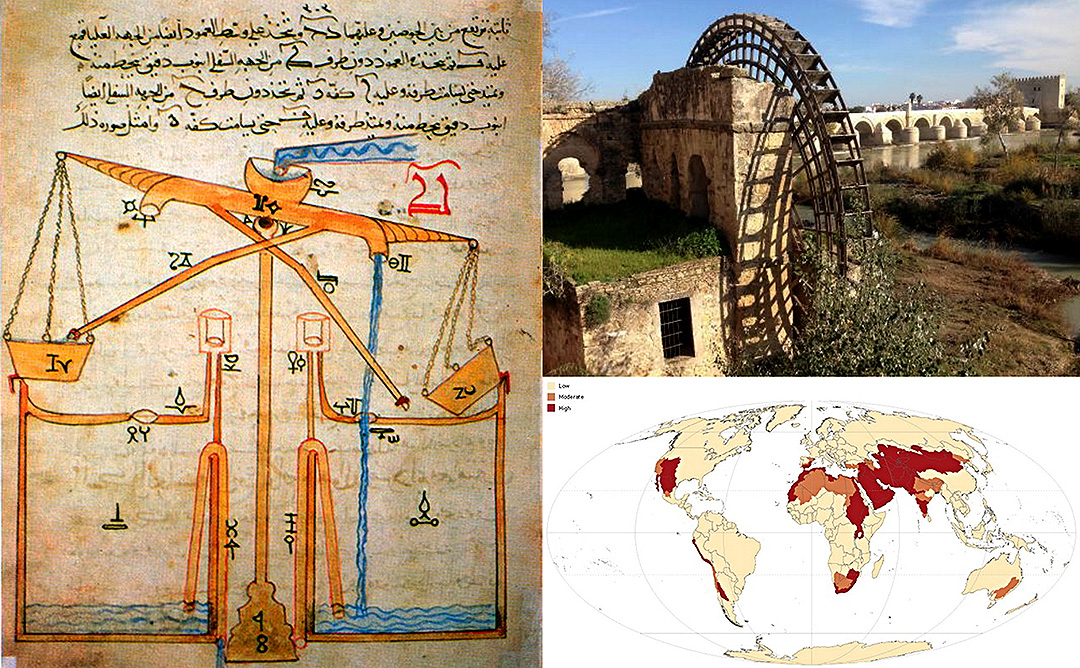
Mechanical machinery in the medieval centuries used clean sources of energy to generate motion and mechanical power. Different types of prime movers began to appear from the 9th century AC in Iraq and then spread east with various applications. Genius Arabic mechanical engineers invented windmills, overshot water wheels (turbines), and undershot water wheels, and used them in various engineering machinery for the welfare of humanity. The role of Arabic/Muslim engineers in this field is acknowledged by many researchers, scientists, and mechanical engineers around the world.
Hill (1974) translated an annotated Al-Jazari manuscript on ingenious mechanical devices. As a mechanical engineer, he reproduced some of the manuscript drawings and provided modern explanations for their operation. He also handled Islamic technology up to Al-Jazari, including the works of Banu Musa, Al-Khuwarizmi and Ridwan.
Hill (1977) cited a manuscript dated 1266 AC belonging to Ibn Muadh Al-Jayyani (died 1079 AC). He pointed out that Al-Jayyani’s treatise consists of 31 models, in which models numbers 1-5 are very large toys similar to automatic clocks but without precise timing. Models 6-20 and 27-30 are water clocks recording the hours by a moving automaton. Models 25 and 26 are raising-water machines. Finally, models 21-24 are war machines, and 31 is a universal sundial.
Al- Hassan (1977) presented the manuscript of Al-Jazari after redrawing some of Al-Jazari’s machines with English letters, concentrating on Al-Jazari’s machines for raising water. He provided an English-Arabic Glossary for the terms used in Al-Jazari’s manuscript.
Coomamswamy (1994) pointed out that the Museum of Fine Arts of Boston possesses six leaves of the Arabic manuscript on Automata. He inferred that Al-Jazari was first and foremost a craftsman and secondarily an author. His writing was intelligible, and his diagrams were clear, explaining his practical experience.
Hill (1998) claimed that until modern times, no other document from any cultural area provided a comparable wealth of instructions for the design, manufacture, and assembly of machines like those of Al-Jazari, a creative engineer who added several mechanical and hydraulic devices. The impact of Al-Jazari’s inventions (as he said) was seen in the later design of steam engines and internal combustion engines.
Mansour (2002) pointed out recorded contributions to the area of automatic control. He investigated the work of Banu Musa, Al-Muradi, Ridwan Al-Saati and Al-Jazari.
Shakerin (2004) provided a review of innovative fountains developed through history, including Al-Jazari’s fountains.
Hassaan (2004) introduced Banu Musa as the founders of feedback automatic control in the 9th century AC and reviewed their scientific activities with emphasis on their book Kitab al-Hiyal (Ingenious Mechanical Devices). He analysed two of their level control systems.
Sindi (2005) clarified that some Arab clocks used water, burning candles, and mercury to move their timepieces. He pointed out the known historical event of the gift of Abbasid Caliph Haroon Al-Rashid (died 809 AC) to the French King Charlemagne, which was a water clock, and how the French king was totally impressed by it.
Al-Hassan (2007) described the operation of the elephant clock of Al-Jazari and the characteristics of a physical model built and located in Ibn Battota Mall, Dubai. The model weighs 7.5 tons and is 7 m tall. He also described some of Banu Musa’s inventions, such as the mechanical jars.
Nadarajan (2007) declared that the mechanical devices were the most comprehensive and methodical compilation of the most current knowledge about automated devices and mechanics.
Al-Hassan (2008) analysed the geometric and physical principles lying behind the mechanical devices of Banu Musa with the help of basic line drawings and 3D computer-generated representations. He presented the basic shapes of Banu Musa fountain outputs, which are: lily, shield and spear styles. He referred to Banu Musa’s use of a wind/water turbine to alternate water shapes [12]. Uzun and Vatansever (2008) stated that Al-Jazari invented the crankshaft and some of the first mechanical clocks driven by water and weight. They said that his use of the crankshaft came before that of the Western engineers Francesco Martini and Leonardo da Vinci.
Abdallah (2009) highlighted that Muslim scholars, inventors, and mechanical engineers used the dynamics of water and its power to design and control mechanical devices. He presented the elephant clock of Al-Jazari and its available physical model. He stated that this clock is classified as fine technology as it is used for amusement or for astronomical observation and computation.
Romshare and Zeghloul (2010) pointed out that two of Al-Jazari’s machines are most remarkable: his elephant clock and one of his water pumps. The elephant clock was the most sophisticated clock at that time, and the water pump used a crank-slider-like system, which was the first known machine to use a crank.
Ambrosetti (2010) pointed out that in the Arabic world from Baghdad to al-Andalus, mechanical culture and practice underwent an extraordinary development. She mentioned the work of Banu Musa, Al-Jazari, and Al-Muradi as witnesses to the extraordinary development of mechanical devices.
Masood (2010) declared that Banu Musa designed industrial and scientific machines. They described ingenious devices in their book, each a masterpiece of ingenuity.
Shuriye and Faris (2011) pointed out that in the Islamic history of knowledge, engineering ranked high, and their engineers have made immense contributions to this field. Early scholars, including Al-Battani, Al-Bairuni, Al-Razi, Jabir ibn Hayyan and Al-Zarqali, have mastered engineering sciences for the service of mankind.
Bruton (2011) presented Al-Jazari’s elephant clock in one of his manuscript copies and a physical model built for the clock. He also presented a physical model for Al-Jazari’s castle clock, a copy and physical model of his cup clock and one of his positive displacement pumps.
Ness et al. (2011) described the adaptation of available techniques to address one of the practical problems experienced with music robots. They pointed out mechanical birds playing the piano, as in the early 19th century. This means they did not read Donald Hill’s translation of Al-Jazari’s treatise in 1974.
Dergisi (2012) presented and described the colored design of Al-Jazari for the elephant clock and the two-cylinder positive displacement pump.
Still (2013) praised the work of Banu Musa and Al-Jazari as designers of programmable music players and humanoid automata that depicted many machines, such as one that measured bloodletting, which was established with a pair of automatic scribes.
Mangun (2014) acknowledged that Islamic civilisation emerged around 750 and lasted until around 1500, during which theoretical studies, discoveries, innovations, and inventions were encouraged to improve people’s lives during the Islamic Golden Age.
Ul-Haque (2014) pointed out that in Islamic society, several individuals and groups of scientists devoted their lives to mechanical engineering and automation. He talked about the three brothers (Banu Musa) and Al-Jazari and how they contributed to the development of mechanical engineering.

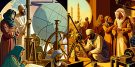
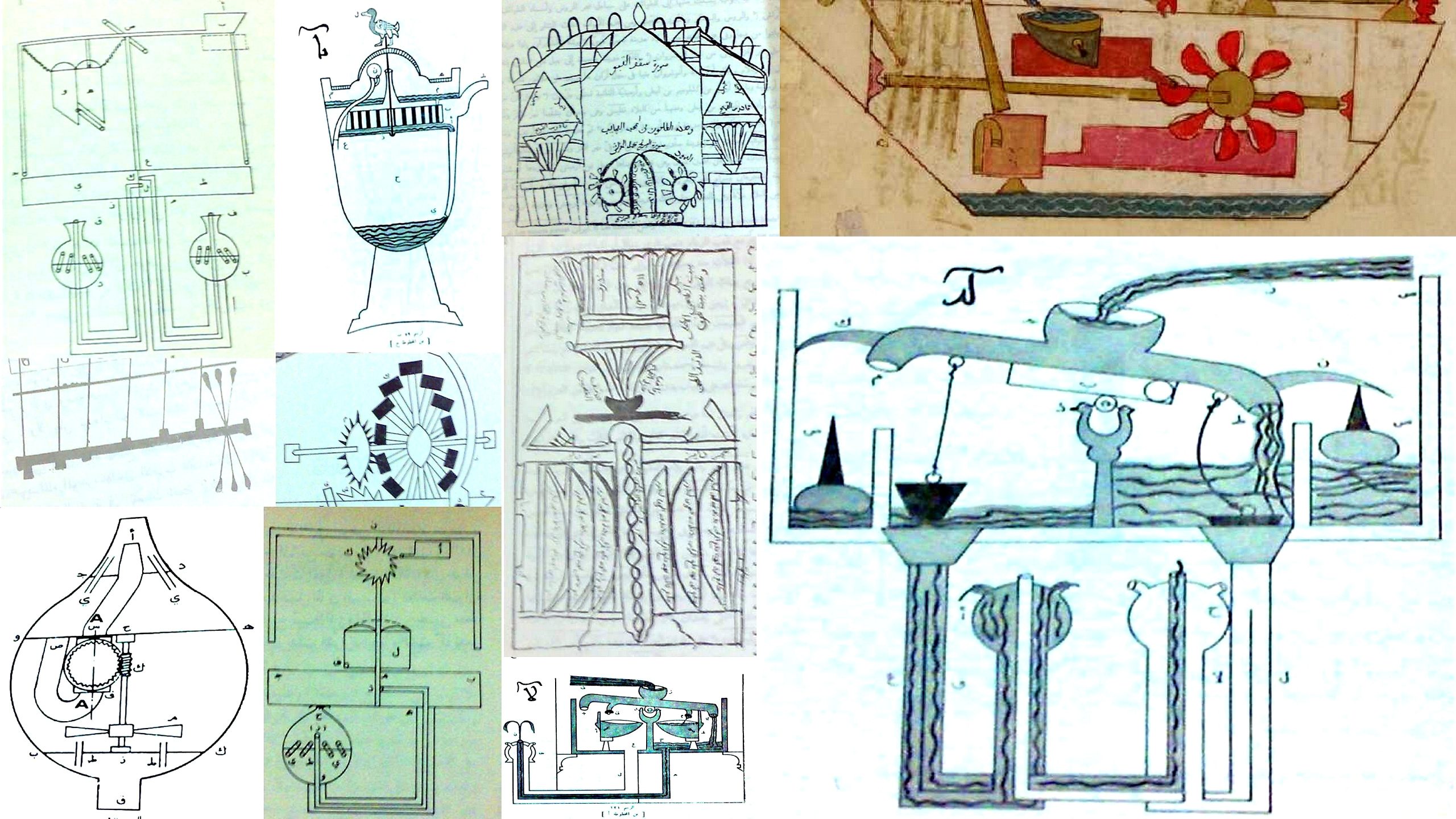
Artist impression of water raising machines designed by Al-Jazari (©1001inventions)

Discover the golden
age of Muslim civilisation.

© Copyright FSTC Ltd 2002-2020. All Rights Reserved.