

Scholars from Muslim Civilisation such as Jaber ibn Haiyan (Jabir ibn Hayyan) and Al-Razi laid the foundations of modern chemistry through their experiments and descriptions of chemical substances and processes. Al-Razi’s Secret of Secrets is seen as an early laboratory manual. Their discoveries, including inorganic acids, had lasting industrial and military impact. In pharmacology and pharmacy, Muslim civilisations advanced drug composition and preparation, drawing and expanding on Greek, Persian, and Indian knowledge. They introduced syrups, juleps, and apothecaries. such as Ibn al-Baytar’s botanical work was a key reference in Europe until the Renaissance.
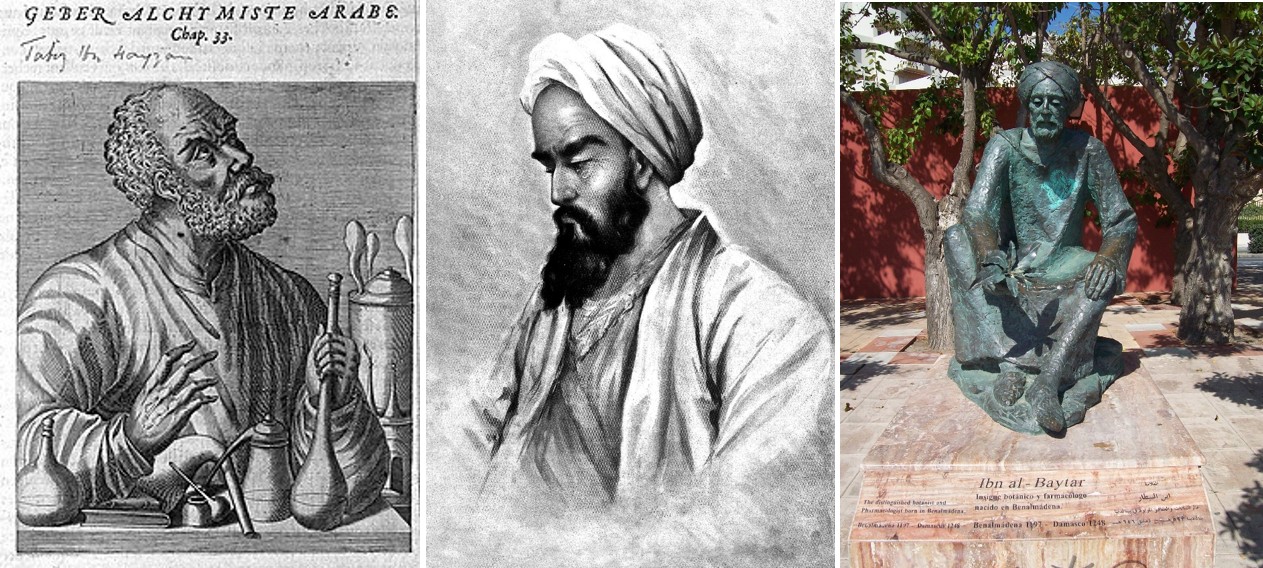
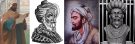
Figure 1. Jabir ibn Hayyan, Latinised name Geber (d. 806-16), Al-Razi, Latinised name Rhazes (d. 925), Ibn al-Baytar (d.1248)
***
Editor’s Note: This extract will be part of a series of short articles based on Dr. Yasmeen Mahnaz Faruqi’s article, “Contributions of Islamic Scholars to the Scientific Enterprise”, originally published in the International Education Journal.
***
In chemistry, the works of Jaber ibn Haiyan and Al-Razi formed the basis of modern science. Jaber, known as Geber in Latin, described in his works the preparation of many chemical substances: the sulphide of mercury, oxides and arsenic compounds. Al-Razi, in his book Secret of Secrets, known as Liber secretorum bubacaris, described the chemical processes and experiments he conducted. Hill (1993, p.83) has stated that Al-Razi’s book Secret of Secrets ‘foreshadows a laboratory manual, it deals with substances, equipment and procedures.
Chemists from Muslim civilisation developed recipes for products that had industrial and military applications. The discovery of inorganic acids during chemical experiments had valuable industrial applications in the centuries that followed.

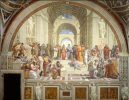
Figure 2. The Advent of Experimental Chemistry
In the fields of pharmacology and pharmacy, Muslims made notable progress. These fields involved scientific investigation into the composition, dosages, uses and therapeutic effects of drugs. Having translations of Dioscorides’ De Materis Medica, along with knowledge from Syria, Persia, India and the Far East, scholars and physicians from Muslim civilisation showed great innovative skills.
Scholars from Muslim civilisation developed the procedures for the manufacture of syrups and juleps, and established apothecary shops (Turner, 1995). Ibn al-Baytar’s book Al-Jami‘fi al-Tibb (Collection of Simple Diets and Drugs) contained detailed records of the plants in the lands along the length of the Mediterranean coast between Spain and Syria. In addition, he systematically compared this knowledge with that of the scientists of previous eras. His book on botany was used until the Renaissance by Europeans.
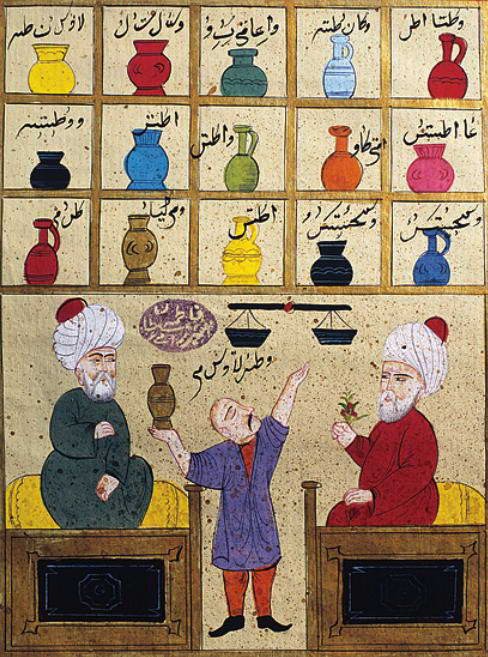
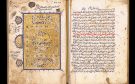
Figure 3. Medical flasks and bottles can be seen in this Ottoman manuscript about the Islamic market, medicine and pharmacy. (Source)

Discover the golden
age of Muslim civilisation.

© Copyright FSTC Ltd 2002-2020. All Rights Reserved.