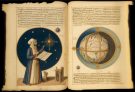
The taifa period of al-Andalus (1031–1086), though politically fragmented after the fall of the Caliphate of Córdoba, became a vibrant era for science and culture. With multiple small kingdoms competing for prestige, rulers and private patrons actively supported scholars, poets, and scientists. Cities like Zaragoza, Toledo, and Seville emerged as key centers of mathematics, astronomy, pharmacology, and agronomy, while individual scholars thrived in Córdoba, Valencia, and Jaén. Unlike earlier centuries, this period saw fewer links to Eastern scholarship, as Andalusi intellectuals increasingly considered their cultural achievements on par with Baghdad or Cairo. This relative isolation fostered original developments, especially in astronomy, and marked a golden half-century of independent scientific creativity in medieval Spain.

Figure 1. Andalusia and Granada by Novissima Projezione (Wikipedia)
***
Editor’s Note:
This article is an excerpt from Chapter 20 in Alejandro Garcia Sanjuan (ed.), The Taifa Kingdoms. Reconsidering 11th-Century Iberia. In HdO, Brill, Leiden-Boston, 2025, pp. 585-625.
***

Figure 2. Detail of the Aljaferia palace, in the Taifa of Zaragoza (Wikipedia)
The taifa period lasted some fifty years (1031–1086), which has been described elsewhere [1] as the golden century of Andalusi science, although it would be more appropriate to speak of a golden half-century. After the fall of the Caliphate and the following period of anarchy and civil wars (fitna), the country lost its political unity, although this did not imply a cultural decay, but exactly the contrary. The reason is simple: in the previous century, cultural and scientific activity was limited to one city (Córdoba) and to the patronage of the Caliph.
From the early eleventh century onwards, the number of patrons increased, as the kings of the small taifa kingdoms were interested in having scientists and poets at their service.[2] Sovereigns like al-Maʾmūn of Toledo (1043–1075) (whose laqab is probably the result of a mimesis of that of the famous Abbasid caliph patron of astronomy), al-Muqtadir (1047–1081) and al-Muʾtaman (1081–1085) of Zaragoza, and al-Muʿtaḍiḍ (1042–1069) and al-Muʿtamid (1069–1095) of Seville are clear examples of scientific patronage exerted by kings.
We should add to them the existence of patrons unrelated to political power: in Toledo the Banū Dhakwān family supported the studies of the physician and astronomer Muḥammad b. Sulaymān b. al-Ḥannāṭ (d. 1045).[3]
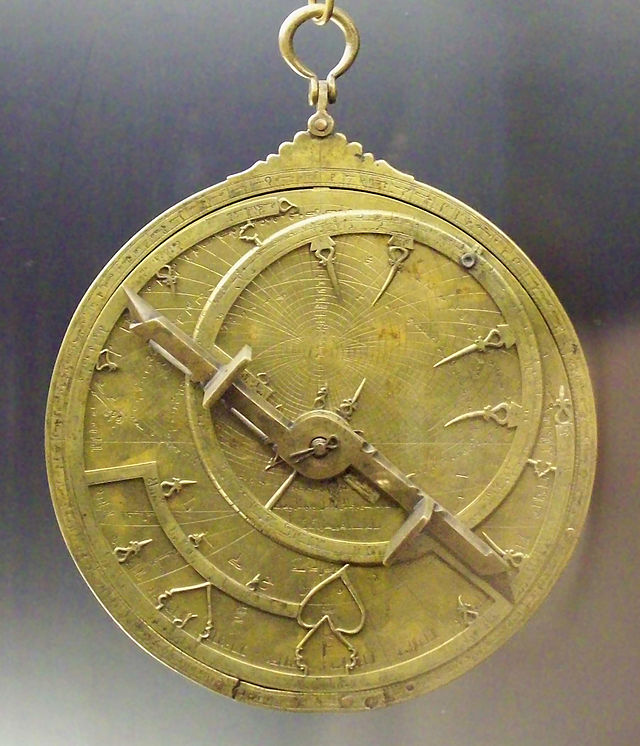
Figure 3. Called Al-Sahlî’s Astrolabe. Planispheric astrolabe from Islamic Iberia. On the back, written in Arabic, is the artist’s name Ibrāhīm ibn Saʿīd al-Sahlī and the year made 459 of Hijra (1067 CE) in Toledo, Muslim Spain (Wikipedia)
The most important case is, however, that of qāḍī Ṣāʿid of Toledo (1029–1070), the author of the well-known Kitāb ṭabaqāt al-umam, who gathered around him the team of astronomers who composed the Toledan Tables. The aforementioned list of patrons shows the existence of new scientific centers, mainly in three cities characterized by a certain degree of specialization: Zaragoza (mathematics and pharmacology), Toledo (astronomy, technology, and agronomy), and Seville (agronomy). To this one should add other three cities which deserve mention because of the presence of an individual important scholar: Córdoba, where Ibn al-Zarqālluh (d. 1100) spent the last years of his life, probably as a result of the conquest of Toledo in 1085 by Alfonso VI of Castile; Valencia, where the mathematician Ibn Sayyid (fl. 1087–1096) lived, and Jaén (Jayyān), where the great mathematician Ibn Muʿādh (d. 1093) carried out his scientific activities.
The taifa period is also characterized by a certain degree of isolation from Eastern scientific activities, resulting in a rather original scientific development, which is obvious in the field of astronomy. During the caliphate, and especially during the reign of al-Ḥakam II (961–976), the royal library of Córdoba was perfectly aware of the main books published in the Mashriq, which were bought and were accessible to the most important scholars who worked in the service of the caliph. This was interrupted during the taifa period, as the rulers of the small kingdoms did not seem to have the financial capacity to maintain great general libraries and acquire new Eastern books. It is obvious that there were specialized libraries in Zaragoza, Toledo, and Seville, but none of them could compete with the great royal library of Córdoba which sources claim to have contained 400,000 volumes. There are exceptions, of course, but most of the books published in the Mashriq after 950 CE never reached al-Andalus, and consequently were not accessible to the Latin translators of the twelfth and thirteenth centuries.

Isolation is also the result of another factor: from the eleventh century onwards, Andalusi scholars seem to have believed that a student did not need to complete his education by travelling to the great capitals of the East, and that the cultural level of al-Andalus was equivalent to that of Baghdad, Damascus, or Cairo. A statistical survey based on the Biblioteca de al-Ándalus [4] shows a major reduction in the number of “journeys in search of knowledge” (riḥlāt fī ṭalab al-ʿilm) to the East undertaken by Andalusi scholars in the eleventh and following centuries, and an increase in their travels to the Maghrib. Indeed, first-rate scholars such as Ibn Ḥazm, Ibn al-Zarqālluh, Ibn Rushd, and Ibn Zuhr do not seem to have travelled eastwards.

Figure 4. Statue of Abén Házam (Ibn Hazm) in Córdoba, Spain (Wikipedia), Figure 5. Ibn al-Zarqālluh’s (also known as Al-Zarqali) moon crater, next to Alphonse’s and Ptolemy’s moon craters. In Latin, he was referred to as Arzachel or Arsechieles (Wikipedia), Figure 6. Statue of Ibn Rushd, Latinised name Averroes, Córdoba, Spain (Wikipedia), Figure 7. Ibn Zuhr, Latinised name Avenzoar (Wikipedia)
[1] J. Samsó, Las ciencias de los antiguos en al-Andalus, Almería: Fundación Ibn Tufayl de Estudios Árabes, 22011, 125–305.
[2] M. Forcada, “Scholarly communities dedicated to the sciences in al-Andalus,” in Sonja Brentjes (ed.), Routledge handbook on the sciences in Islamicate societies: Practices from the 2nd/8th to the 13th/19th centuries, London: Routledge, 2022, 612–615.
[3] M.G. Balty Guesdon, Médecins et hommes de sciences en Espagne musulmane, (IIe/VIIIe–Ve/XIe s.), Paris (PhD Diss.): Sorbonne Nouvelle, 1992, 283, 643–644.
[4] J. Lirola and J.M. Puerta (eds.), Enciclopedia de la cultura Andalusí. Biblioteca de al-Andalus, 8 vols., Almería: Fundación Ibn Tufayl, 2004–2012.

Discover the golden
age of Muslim civilisation.

© Copyright FSTC Ltd 2002-2020. All Rights Reserved.