

Book Review of “Reflections on Observational Astronomy in the Medieval Islamic Period” by S. Mohammad Mozaffari
by Fatima Sharif
Starting on the 26th April 2025, the Royal Observatory Greenwich will host a programme of planetarium shows celebrating the Muslim world’s contributions to astronomy.
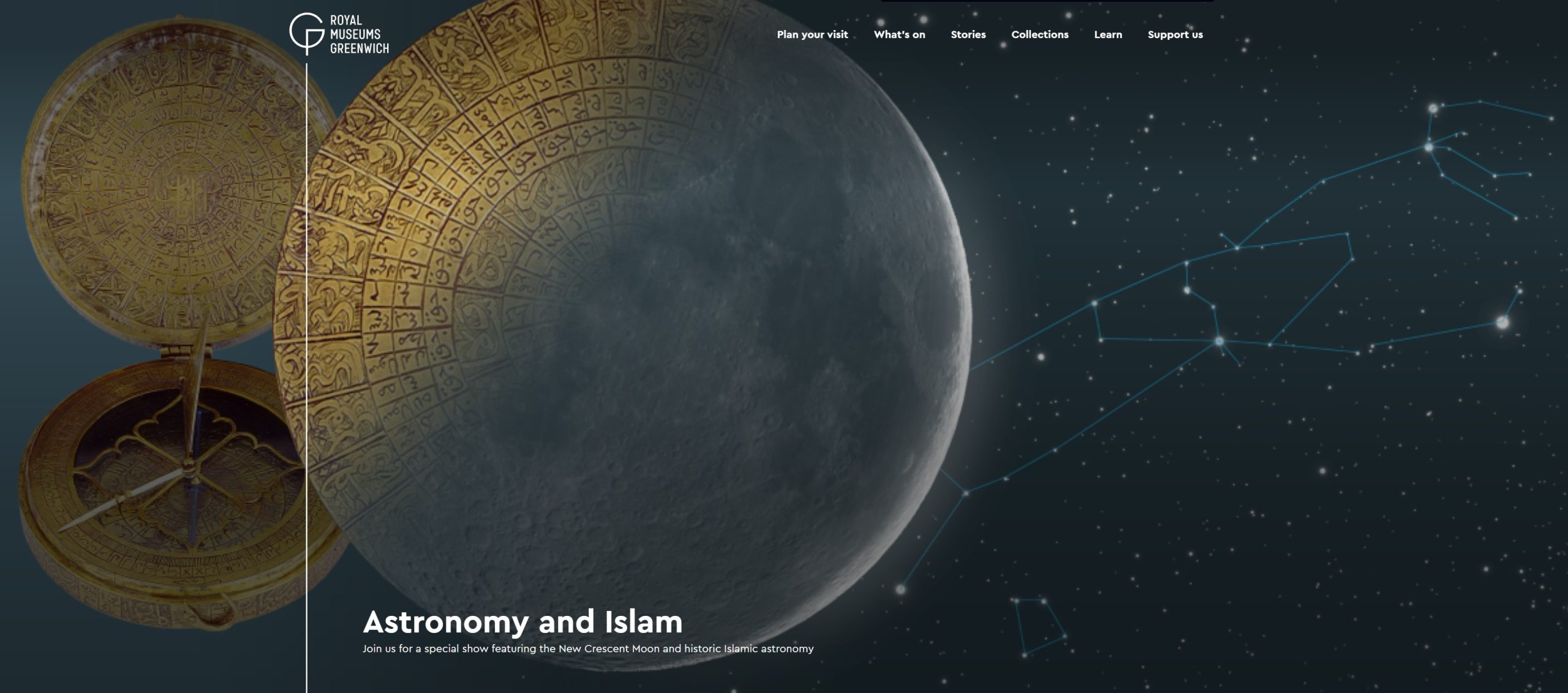
Screenshot of the Royal Observatory Greenwich website
Aisha Rimi reports from hyphenonline.com: At the Royal Observatory Greenwich, a programme of planetarium shows over the next seven months, from 26 April 2025, offers a different way of looking at the night sky. Astronomy and Islam explores how astronomy is woven into the daily lives of Muslims — from determining prayer times and finding the direction of Mecca, to marking the start of Ramadan and other Islamic months.
Astronomy and Islam is an occasional programme of events, developed in partnership with the Muslim-led community astronomy group New Crescent Society. Since its first series of shows, held in 2017, it has become one of the observatory’s most popular draws, with tickets regularly selling out. Each show runs the weekend before the predicted sighting of the new crescent moon, giving people a chance to learn how to sight the event for themselves.
Jake Foster, a public astronomy officer at the Royal Observatory, says:
“We bring the science, and the New Crescent Society bring the religious and cultural expertise, together, we’ve created something genuinely meaningful for the community.”
As well as teaching people how to spot the new crescent moon, Foster hopes that the events also highlight a part of scientific history that all too often goes ignored.
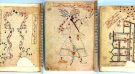
“Arabic astronomers like Al-Sufi, who created some of the earliest imagery of the constellations, laid the foundations for the Greeks and the Romans and informed what we know today, I hope visitors walk away with an appreciation of how important a role Islam has played in modern astronomy.”
Foster also sees the programme as a counterpoint to the idea that science and religion do not mix:
“We want people to walk away feeling excited about moon sighting, It’s not just a calendar exercise. It’s an emotional, joyful moment for many people. Some describe seeing the crescent moon as bringing them to tears.”
Here’s what to expect from the series:

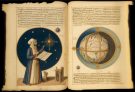
Astronomical atlas from “Al Sufi”. Middle of the XIVth century, from nord of Italy. Exhibited in Strahov monastery’s library, Prague. (Source)

Discover the golden
age of Muslim civilisation.

© Copyright FSTC Ltd 2002-2020. All Rights Reserved.