The Islamic scientific tradition has been described many times in accounts of Islamic civilization and general histories of science, with most authors tracing its beginnings to the appropriation of ideas from other ancient civilizations—the Greeks in particular...
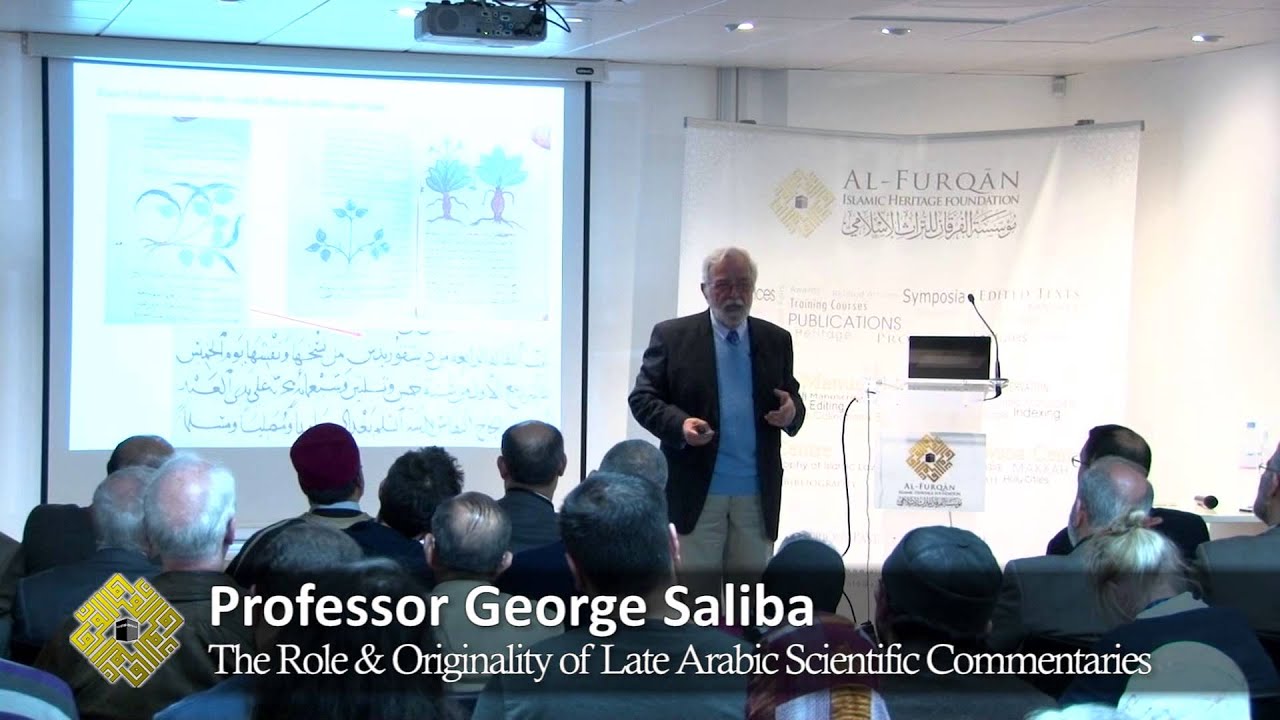
George Saliba is Professor of Arabic and Islamic Studies in the Department of Middle East and Asian Studies at Columbia University. He is the author of the book “Islamic Science and the Making of the European Renaissance ”
About the book “Islamic Science and the Making of the European Renaissance ” :-
The Islamic scientific tradition has been described many times in accounts of Islamic civilization and general histories of science, with most authors tracing its beginnings to the appropriation of ideas from other ancient civilizations—the Greeks in particular. In this thought-provoking and original book, George Saliba argues that, contrary to the generally accepted view, the foundations of Islamic scientific thought were laid well before Greek sources were formally translated into Arabic in the ninth century. Drawing on an account by the tenth-century intellectual historian Ibn al-Nadīm that is ignored by most modern scholars, Saliba suggests that early translations from mainly Persian and Greek sources outlining elementary scientific ideas for the use of government departments were the impetus for the development of the Islamic scientific tradition. He argues further that there was an organic relationship between the Islamic scientific thought that developed in later centuries and the science that came into being in Europe during the Renaissance.
Saliba outlines the conventional accounts of Islamic science, then discusses their shortcomings and proposes an alternate narrative. Using astronomy as a template for understanding the progress of science in Islamic civilization, Saliba demonstrates the originality of Islamic scientific thought. He details the innovations (including new mathematical tools) made by the Islamic astronomers from the thirteenth to sixteenth centuries, and offers evidence that Copernicus could have known of and drawn on their work. Rather than viewing the rise and fall of Islamic science from the often-narrated perspectives of politics and religion, Saliba focuses on the scientific production itself and the complex social, economic, and intellectual conditions that made it possible.
by Ekmeleddin Ihsanoglu Published on: 21st April 2004
The development of madrasas was greatly influenced by the impact of a strengthened central state authority and the resulting political stability and economic well-being it brought to the society. Toward the end of the sixteenth…
The Islamic scientific tradition has been described many times in accounts of Islamic civilization and general histories of science, with most authors tracing its beginnings to the appropriation of ideas from other ancient civilizations—the Greeks…
Ibn Jubair is widely recognised as one of the greatest travellers and geographers of Muslim history. From excerpts his work, The Travels of Ibn Jubair, as presented in this short article we are able to…
Muslims stand responsible for their own decadence. After the early conquests, Islamic rule became very corrupt, and this considerably weakened the caliphate. Islam produced great leaders but also some weak ones, which combined over time…
It is actually a hostility to Berbers and Turks that explains their being blamed for the decadence of Islam. The Seljuk role, it could be said, was in actual fact instrumental in saving whole Islamic…
Why did Islamic civilisation fall into decline? This article seeks to correct some misunderstandings and open the debate about what went wrong and what can be done to put it right.
Attacks on Islamic centres of wealth on land and on sea by Western Christian pirates greatly reduced the economic power of Muslim lands. North Africa became economically impoverished as the Trans-Saharan traffic, which had sustained…
Eurocentric myths about Western scientific and technological superiority persist in popular culture and some scholarly circles. A prevalent myth suggests that Islamic contributions to modern science were primarily the transmission of ancient Greek and Roman…
Throughout history one of the greatest disasters humankind has seen are epidemics. In their most critical times, they have killed millions, causing people to migrate, paralyzing work forces, agriculture and stockbreeding decline, creating numerous negative…
The 14th-century historiographer and historian Abu Zayd ‘Abd al-Rahman ibn Khaldun was a brilliant scholar and thinker now viewed as a founder of modern historiography, sociology and economics. Living in one of human kind's most…
This is a review of a book by Sayyed Misbah Deen, Emeritus Professor of Computer Science (Keele University), describing the adventure of science and technology in Islam from four standpoints: the rise of science and…
While John teaches you about this long-lived Muslim empire, he'll also look at the idea of historical reputation and how we view people from history...
Cash endowments contributed to Ottoman society, without any cost to the State, by organizing and financing expenditures on education, health, welfare and a host of other activities. The aim of this article is to discover…
The following article presents a survey on some glorious pages of the history of Kairouan, the ancient capital of the Islamic Ifriqiya (present day Tunisia). Founded in 670 by ‘Uqba ibn Nafi', the Arab general…
Most students of Islamic civilisation are still under the impression that the golden age of that civilisation, in terms of philosophical and scientific production, came to an end sometime around the beginning of the thirteenth-century…
There is a major fallacy in the concept of the 'Dark Ages'. That period coincides exactly with the Muslim apogee. In the midst of Europe's darkness, almost immediately after the fall of the Roman Empire,…
by Salah Zaimeche Published on: 30th December 2001
Dams are required in most hydraulic systems, for irrigation, regulating flow of rivers and in modern times for the production of energy. In the classical Islamic world, dam construction received a special attention as an…
It is often supposed in Islamic studies that Al-Ghazali demolished the basis for science in the Muslim world by his so-called orthodox attack against rational thinking which nurtured a negative climate that resulted in the…
by Abdul Azim Islahi Published on: 26th March 2010
Ibn Khaldun's theory of taxation has been considered one of his most important contributions to economic thought. In the Muqaddimah, he relates the theory of taxation with the government expenditure and argued for low tax…
This website uses cookies to improve your experience. We'll assume you're ok with this, but you can opt-out if you wish. Cookie settingsACCEPT
Privacy & Cookies Policy
Privacy Overview
This website uses cookies to improve your experience while you navigate through the website. Out of these cookies, the cookies that are categorized as necessary are stored on your browser as they are as essential for the working of basic functionalities of the website. We also use third-party cookies that help us analyze and understand how you use this website. These cookies will be stored in your browser only with your consent. You also have the option to opt-out of these cookies. But opting out of some of these cookies may have an effect on your browsing experience.
Necessary cookies are absolutely essential for the website to function properly. This category only includes cookies that ensures basic functionalities and security features of the website. These cookies do not store any personal information.