The medical scholars during the medieval Islamic era placed great emphasis on the value of dissection and the knowledge of anatomy for the diagnosis of affected organs, the relationships of the organs to one another and the application of adequate medical and surgical treatment...
All the medical scholars in the Islamic era, as well as Ibn al-Nafīs, followed the description of the pulmonary vessels by Galen and his predecessors, and agreed with Galen that man and all animals which have lungs have a right ventricle, too, which Galen described as “a common passage or a cistern, so to speak, in which one vessel with a single tunic is inserted into it and another with double tunics issues from it, and the blood is attracted to it through one of the vessels and expelled from it through the other”.85,86 Meanwhile, they as well as Galen believed that the right ventricle is necessary for the thinning and warming of the incoming blood to the heart, as according to Ibn al-Nafīs only, if air gets mixed with the blood while it is still thick, the resulting mix will not be of homogenous particles.87 Also, they admitted that the vital role of the heart is the formation of the vital pneuma in the left ventricle and its distribution all over the body by the arteries. This pneuma is thin, light, and mobile, as it is formed from the thinnest blood which is well mixed with the attenuated air (pneuma), hence in the left ventricle, according to Ibn al-Nafīs, there must be present attenuated air (pneuma) and very thin blood, so that vital pneuma could be formed from their mixture.88,89,90 So, all the medical scholars before Ibn al-Nafīs agreed with Galen that the attenuated air (pneuma) might flow easily into the heart, attracting it during the diastole, and followed his assumption that the two ventricles are connected through invisible pores in the interventricular septum, and a considerable amount of blood is taken over through it from the right to the left ventricle.91,92,93,94

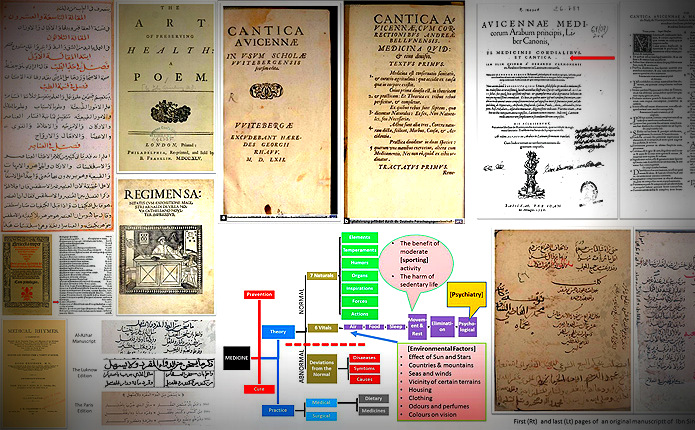
Figure 1: A manuscript page from Ibn al-Nafis’ Commentary on Avicenna’s Canon (Source)
However, Ibn al-Nafīs proved anatomically that, in the interventricular septum, there are no pores, whether visible or invisible, as it is not porous but compact, even more than any other part, and there is no communication between the two ventricles at all.95 Therefore, contrary to Galen, Ibn al-Nafīs believed that all the attenuated blood in the right ventricle must be expelled through the arterial vein (pulmonary artery) and its branches into the lung substance which fill the spaces at the division of the vessels and concocts the outer air filling it.96 Meanwhile, the thick-walled arterial vein (pulmonary artery) and its branches permit only the thinnest blood to filter out into the substance of the lung. Hence, this filtrate gets mixed with a large amount of previously attenuated air in the lung spaces. Then, the formed mixture must be concocted in the lung until it becomes thin spirituous blood which is suitable for the formation of the vital pneuma in the left ventricle of the heart.97 In addition, unlike Galen, Ibn al-Nafīs believed that a simple element like the attenuated air (pneuma) on its own was not eligible as nutriment, but when well mixed and concocted with the thinnest, warm, blood and forming the hot, thin, spirituous blood, then it becomes suitable nutriment for the nourishment of the vital pneuma in the left ventricle of the heart.98,99 Hence, according to Ibn al-Nafīs, the thin, warm and spirituous blood formed in the substance of the lung penetrates easily into the thin-walled venous arteries (pulmonary veins) through its terminal pores to reach the left ventricle of the heart to nourish the vital pneuma.100 Therefore, according to him, the blood in the left ventricle comes from the lung and not from the right ventricle, as was believed by Galen.
Furthermore, Ibn al-Nafīs believed that, originally, the left ventricle was not suitable for the formation of the thin spirituous blood which is necessary for the nourishment of the vital pneuma, as the heart is in continuous movement of systole and diastole, which will not allow for the required time needed for the effective mixing and concocting of the attenuated air with the hot thinnest blood. Furthermore, the alternative and more suitable place for the mixing and concocting of that mixture should have plenty of attenuated air. Therefore, the lung, in addition to being near to the heart, represents the most suitable place for this process to take place.101
On the other hand, Ibn al-Nafīs suggested that the thin spirituous blood does not, instead, penetrate the terminal ends of the rough arteries in the lung (branches of the windpipe), not because of their naturally nicely proportioned size, which permits vapour and air but remains impassable to blood and other thick substances, unless they loose their natural adjustment of size in the case of wounds or diseases, as was suggested by Galen, but rather due to a retentive faculty present in the lung that holds on to what is beneficial and expels what is harmful to it.102,103
Also, according to Ibn al-Nafīs, what is left in the branches of the arterial vein (pulmonary artery) is the thicker part of its blood. It will come out from its terminal pores and is consumed for the nourishment of the lung substance.104 Thus, he contradicts Galen’s assumption that the nourishment of the lung must be basically by thin spirituous blood coming to it from the heart through the venous arteries (pulmonary veins). Ibn al-Nafīs stated that this thin spirituous blood is not suitable for its nourishment because the lung substance is not so thin that it needs such blood. On the contrary, it is fleshy and humid, hence its nourishment should be of watery rather than spirituous blood.105
Therefore, according to Ibn al-Nafīs, the venous arteries (pulmonary veins) contain thin spirituous blood coming to them only from the lung and not from the heart. However, in agreement with Galen, he stated that during the contraction of the heart, all that is sooty and fuliginous is poured off through the venous arteries (pulmonary veins) to return to the lung to be expelled in the expiration.106

Figure 2: Approximate timeline showing the period of the Islamic Golden Age and the long influence of the teachings of the Galen School. (Source)
Furthermore, while Galen considered that the arteries accompanying the veins of the heart are for cooling it, Ibn al-Nafīs considered them to supply the vital pneuma to all its parts, except the left ventricle and interventricular septum, because of their direct contact with it.107
Therefore, the above-mentioned physiological concept of the circulation of blood from the right ventricle to the lungs and then to the left ventricle, based on the anatomical fact that the interventricular septum is not porous, made Ibn al-Nafīs the greatest physiologist of the medieval Islamic era.

Discover the golden
age of Muslim civilisation.

© Copyright FSTC Ltd 2002-2020. All Rights Reserved.