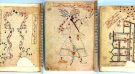
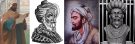
Long before the telescope, scholars from Muslim Civilisation were mapping the skies with incredible precision. Building on ancient works like Ptolemy’s Almagest, they translated, tested, and corrected ancient theories through their own detailed observations. Al-Khwarizmi pioneered astronomical tables (zij), while Al-Farghani’s writings guided Europe and Central Asia for centuries. By the 13th century, thinkers like Al-Tusi introduced groundbreaking models such as the “Tusi Couple,” which influenced later astronomers, including Ibn al-Shatir, whose ideas on planetary motion bore striking similarities to those of Copernicus. Whether or not Copernicus saw these manuscripts, Islamic innovations, from treating trigonometry as an independent science to refining planetary models, paved the way for the Renaissance and beyond.
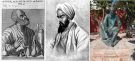
Figure 1. al-Khwarizmi (d. 850) (Wikipedia), Figure 2. Al-Farghani (d. 870) (Wikipedia), Figure 3. Nasir al-Din al-Tusi (d. 1274) (Wikipedia), Figure 4. Ibn al-Shatir (d.1375) (Wikipedia)
***
Editor’s Note: This extract will be part of a series of short articles based on Dr. Yasmeen Mahnaz Faruqi’s article, “Contributions of Islamic Scholars to the Scientific Enterprise”, originally published in the International Education Journal.
***
Muslim scholars considered astronomy as one of the mathematical sciences. Muslims came across ancient astronomical manuscripts and translated them into Arabic. They then undertook observations to verify the calculations in these scientific works. The Greek astronomer Ptolemy had developed an astronomical theory about the movements of the moon and planets; and had placed the earth at the centre of the universe. In order to compensate for errors in observation he had attributed additional movements to the planets. Al-Khwarizmi was one of the first scholars to produce a detailed astronomical table (zij). This astronomical table provided the means of calculating the positions of the stars and planets. Subsequently, each astronomer wrote his own zij, trying to make it more accurate than those prepared before (Beshore, 1998). Al-Farghani, in the ninth century wrote a detailed account of Ptolemy’s Almagest and his book was used throughout Europe and central Asia for the next 700 years (Beshore, 1998, p. 24). This work was the beginnings of the empirical verification of scientific ideas and relationships.
Figure 5. Statue of Muhammad ibn Musa al-Khwarizmi in Urgench, Uzbekistan (Wikimedia)
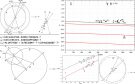
Muslim philosophers and astronomers had inherited the Ptolemaic planetary system that hypothesised the principle of uniform circular motion allowing the planets to move in epicycles. However, Muslim astronomers eventually came to reject this theory in that the epicyclic movement violated the principle of uniformity of motion. In the thirteenth century, Al-Tusi, a Persian astronomer put forward his concept known as the “Tusi Couple”, a hypothetical model of “epicyclic motion that involves a combination of motions each of which was uniform with respect to its own center”(Turner, 1995, p.68). This model was applied by Ibn al-Shatir to the motions of the heavenly bodies in the fourteenth century. Ibn al-Shatir’s formulations were the beginnings of verifying theoretical astronomy through systematic observations.
Figure 6. Ahmed al-Farghani statue in the central park of Ferghana, Uzbekistan (Wikimedia)
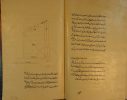
Ibn al-Shatir’s theory of lunar motion was very similar to that attributed to Copernicus some 150 years later (Sabra, 2002). Currently researchers are investigating whether it was possible, that Copernicus visiting the Vatican library in Rome had seen Ibn al-Shatir’s fourteenth century manuscript illustrating his concept of planetary motion (Saliba, 2002). The reason for this supposition being a diagram in Copernicus’ Commentaries that was remarkable similar to Ibn al-Shatir’s schematic diagrams. Whereas Ibn al-Shatir’s concept of planetary motion was conceived in order to play an important role in an earth-centred planetary model, Copernicus used the same concept of motion to present his sun-centred planetary model. Thus the development of alternative models took place that permitted an empirical testing of the models.
Figure 7. From Prof. George Saliba’s website showing both Tusi’s and Copernicus’ drawings (Source)
Whether there was a clearly identifiable connection between the works of these two men today remains unclear, but what needs to be noted is that Muslim innovations in astronomical theory contributed to the historical development of astronomical science (Turner, 1995). These innovations provided new directions for investigations during the ages of the Renaissance and Enlightenment in Europe. Another development that was attributed to al-Tusi, the thirteenth century astronomer, was that he treated trigonometry as a separate field from spherical astronomy. Thus, astronomers could calculate distances and directions of points on the celestial spheres more efficiently, using this new body of mathematical ideas and relationships.
This website uses cookies to improve your experience. We'll assume you're ok with this, but you can opt-out if you wish. Cookie settingsACCEPT
Privacy & Cookies Policy
Privacy Overview
This website uses cookies to improve your experience while you navigate through the website. Out of these cookies, the cookies that are categorized as necessary are stored on your browser as they are as essential for the working of basic functionalities of the website. We also use third-party cookies that help us analyze and understand how you use this website. These cookies will be stored in your browser only with your consent. You also have the option to opt-out of these cookies. But opting out of some of these cookies may have an effect on your browsing experience.
Necessary cookies are absolutely essential for the website to function properly. This category only includes cookies that ensures basic functionalities and security features of the website. These cookies do not store any personal information.