



The Destruction of the Muslim Economic System: A Prime reason for the Decline of Muslim Science
by Salah Zaimeche


Mathematical Science – Contributions of Islamic Scholars to the Scientific Enterprise
by Yasmeen Mahnaz Faruqi
Eurocentric myths about Western scientific and technological superiority persist in popular culture and some scholarly circles. A prevalent myth suggests that Islamic contributions to modern science were primarily the transmission of ancient Greek and Roman knowledge to medieval and early modern Europe. A less extreme version posits significant contributions during Islam's "Golden Age," followed by a decline between the late eleventh and late fourteenth centuries. This paper challenges these narratives, presenting recent scholarship that demonstrates continuous major advances in astronomy, physics, mathematics, and medicine by Islamic scholars throughout the late Middle Ages and into the early modern period. The study underscores the inadequacy of the classical narrative, which claims that Islamic scientific activity declined after an initial period of prosperity. Historians like Eugene von Grunebaum, Otto Neugebauer, and George Saliba have provided evidence that Islamic scholars not only preserved ancient knowledge but also made original contributions that influenced later European developments. This includes advancements in fields such as astronomy, where figures like Nasir al-Din al-Tusi and Ibn al-Shatir developed models later utilized by Copernicus. The paper also highlights continued progress in medicine and mathematics, with scholars like Al-Razi and Ibn Sina making lasting impacts on European scientific thought. The article argues for a re-evaluation of the role of Islamic sciences, emphasizing that many significant contributions remain understudied due to a lack of accessible manuscript sources. By debunking the myth of decline, the paper calls for recognition of the dynamic and sustained intellectual activity within Islamic cultures, which continued to produce influential scientific work well into the early modern era.

Figure 1. A spherical astrolabe from medieval Islamic astronomy, c. 1480, most likely Syria or Egypt, in the Museum of the History of Science, Oxford (Wikipedia)

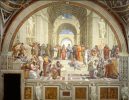
Figure 2. Ibn Rushd (Latinized as Averroes), looking over the shoulder of Pythagoras from the famous “The School of Athens” by Raffaello Sanzio da, creates a powerful visual narrative by highlighting how scholars from Muslim civilisation served as intellectual bridges, preserving and expanding ancient Greek knowledge, which was then transmitted to the West.
“There is infinitely more mental initiative in Muslim historiography and philology than in their obsequious refurbishing of ancient science.”
The quote above from the Austrian historian and Arabist, Gustave von Grunebaum (1909–1972), is emblematic of one of the more persistent of the Eurocentric myths about Western scientific and technological superiority and exceptionalism. According to this myth, the contribution of Islamic cultures to the development of modern science and technology was primarily based in their diffusion of ancient Greek and Roman knowledge to medieval and early modern Europe with little or no modification. Islamic scholars simply preserved the intellectual legacies of the Greeks and Romans in Arabic, and subsequently transmitted to European scholars significant tranches of classical knowledge that had been lost to Europe after the collapse of the Roman Empire (Saliba, 2007).
The most extreme version of the myth holds that astronomy and mathematics stagnated after the death of Claudius Ptolemy (83–c. 168 CE) and were not reawakened until the time of Nicolaus Copernicus (1473–1543). The less extreme version argues that although Islamic scholars made important contributions to the development of medicine, astronomy and mathematics during the so-called ‘Golden Age’ of Islam, there was a significant decline in the quality and quantity of those contributions sometime between the late eleventh and late fourteenth centuries.

Figure 3. Three scholars in dispute over a medicinal cure, miniature from an Arabic translation of Dioscorides’s “De Materia Medica. The Keir Collection of Islamic Art on loan to the Dallas Museum of Art (Wikipedia)
Although there has clearly been a substantial body of scholarship available to Muslim scholars in languages other than English, French and German which has demonstrated the fallacy of these different versions of Islamic intellectual stagnation, most of that scholarship has not been translated for the benefit of Western scholars. Developments over the last forty years in the history and sociology of science and technology have, however, been witness to a major reevaluation of the contribution of non-Western cultures more generally to scientific and technical traditions in the West. A significant body of this scholarship has involved debunking nationalist, rationalist, and Eurocentric myths about the history of science and technology. During that time, specialists in the Islamic sciences from diverse cultural backgrounds have published several dozen important books and articles in English which have sought to demonstrate the important contributions of Islamic scholars to the development of pre-modern science and technology. Their research has exposed the extent to which a number of long-held prejudices and inaccurate assumptions about the development of the Islamic sciences need to be fundamentally re-evaluated, especially by those who claim to champion the exceptional status of the Western canon. In the process of doing so, it has also been demonstrated that key developments in modern science and technology need to be fundamentally revised, especially in relation to astronomy, chemistry, mathematics, mechanics, and medicine.
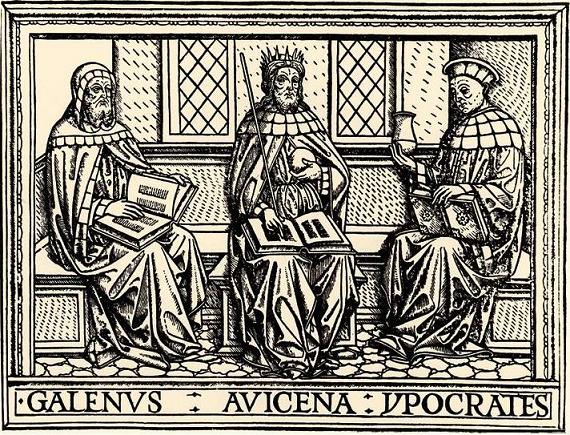
Figure 4. Galen, Ibn Sina (Avicenna), and Hippocrates, the three authorities on medical theory and practice, in a woodcut from an early 15th-century Latin medical book (Source)
This paper attempts to provide colleagues who are not familiar with the relevant research with some idea of the various grounds for criticizing what George Saliba has called ‘the classical narrative’ and the associated myth of Islamic decline (Saliba, 2007). Because it is only intended to provide an overview of the work of some of the more prominent historians who have contributed to this research in the English language over the last century, along with brief descriptions of the important work published by Islamic natural philosophers and scholars from the medieval and early modern periods, it makes no pretence to provide any original research on the relevant topics. Nor does it purport to give any particular insight into the depth and breadth of recent Islamic scholarship on these topics in languages other than English. I claim no special expertise on the topic of the development of the Islamic sciences, nor am I familiar with most of the work of scholars writing about the history of the Islamic sciences which is not published in English. However, as a professional historian, I have maintained an abiding interest in the general topic and have some familiarity with the work of those who have dedicated their academic careers to it.
Because my professional training has been in the post-Kuhnian contextualist tradition in the history of science (Schuster, 1979, 2016), as well as historiographical developments informed by the sociology of scientific knowledge (e.g. Applebaum, 2003; Burns, 2001), I use the term ‘Islamic sciences’ to denote the different historical trajectories and theoretical and methodological development of Islamic medicine, astronomy, mathematics, physics, chemistry, geography, timekeeping and cartography outlined in this discussion. My general intention is to introduce readers to the work of several scholars with extensive knowledge of the topics discussed.

Figure 5. Among Europeans, al-Razi’s most sought-after work was his Kitab al-Hawi fi al-tibb (The Comprehensive Book on Medicine), which was translated into Latin in 1279 under the title Continens Rasis by Faraj ben Salim, a physician of Sicilian-Jewish origin employed by Charles of Anjou to translate medical works. This book is also known in Latin as Continens Liber and in English as The Virtuous Life. Shown here is the rare 1529 edition of Continens Rasis, which was printed in Venice by Johannes Hamman” (Source)
My own research in the history of premodern technology has drawn attention to the extensive contributions of Islamic cultures to the development of medieval machine technology. Those contributions include the conveyance of ancient Egyptian, Roman and Chinese innovations to the Mediterranean and northern Europe in the use of water- and wind-power for a wide range of civic, agricultural, and industrial uses, as well as developments that were undoubtedly autochthonic in origin (Lucas, 2006). This article is an attempt to draw the attention of my English-, Arabic-, Turkish- and Persian-speaking colleagues—as well as others whose first language is not English and whose disciplinary interests lie outside history—to the rich heritage of the Islamic sciences. Methodologically, my paper follows the conventions of a review essay.
The article begins with a brief outline of twentieth- and twenty-first-century academics writing mainly in the English language who sought to provide informed evaluations of early Islamic scholarship and its contribution to the development of the sciences and technology. This is followed by an overview of the classical narrative, along with the accompanying myth of Islamic decline, which supposedly led to the stagnation of natural philosophy and the exact sciences under Islam.
It goes on to describe the development of research by Western scholars going back to the late 1950s, which has noted uncanny resemblances between advances in medieval Islamic astronomy and models of planetary motion developed by Copernicus, and how an understanding of the work of Al-Ghazalī (1058–1111) and Ibn Khaldūn (1332–1406) provides important insights into the development of the Islamic sciences during the period of putative ‘decline’.
It then provides an outline of important but overlooked contributions in astronomy by individuals such as Ali Qūshjī (d. 1474), ‘Abd al-‘Alī al-Bīrjandī (d. 1525 or 1526), Shams al-Dīn al-Khafrī (fl. 1525) and Fatḥ al-Dīn al-Qaysī (d. 1258). Evidence for continued Islamic developments in medicine by Ibn al-Nafīs (d. 1288) and Manṣūr ibn Muḥammad ibn Aḥmad ibn Yūsuf ibn Ilyās (fl. late 14th c.), and in mathematics by Al-Qurashi (d. 1184) and al-Marrākushī (1256–c. 1321), round out the discussion.
Space precludes a discussion of Islamic contributions to the development of chemistry and mechanics. The paper concludes with some general observations about the wealth of material that is yet to be studied by historians working on these topics…
Excerpt reproduced from Adam Lucas, “Re-Evaluating the Development of the Islamic Sciences” (2024), originally published in Unisia, 42(1), pp. 57–86. Licensed under CC BY-SA 4.0.

Discover the golden
age of Muslim civilisation.

© Copyright FSTC Ltd 2002-2020. All Rights Reserved.